Showing posts with label 82nd Lege. Show all posts
Sunday, March 25, 2012
Study: Only 1 in 5 Texas 8th-graders earns any degree within 6 years after high school
By Ralph K.M. Haurwitz | AMERICAN-STATESMAN STAFF
Saturday, March 17, 2012
Dropout rates, graduation rates, retention rates, passing rates for standardized tests — the education arena is flush with statistics.
Now, a private foundation in Houston is seeking to cut through the noise and focus attention in Texas on what it considers the single most valuable measure of educational effectiveness: the percentage of eighth-graders at public schools who go on to earn a postsecondary degree or certificate within six years of their expected high school graduation date.
A study commissioned by the foundation, the Houston Endowment, found that only about 1 in 5 eighth-graders earns such a credential.
"My reaction was, ‘This can't be right.' But it is right," said Larry Faulkner, a former president of the University of Texas who retired last month after six years as president and CEO of the endowment.
The study didn't take a position on what the credential-earning rate should be, other than to say it should be "much larger." But it warned that low rates for some minority groups are especially troubling.
"White students' rates of earning a college credential are two to two and a half times higher than those of Hispanics and blacks," the report said. "Given the state's growing Hispanic population, this means that it will be impossible for Texas to contribute its share in reaching national attainment goals without improving Hispanic college-going and graduation rates."
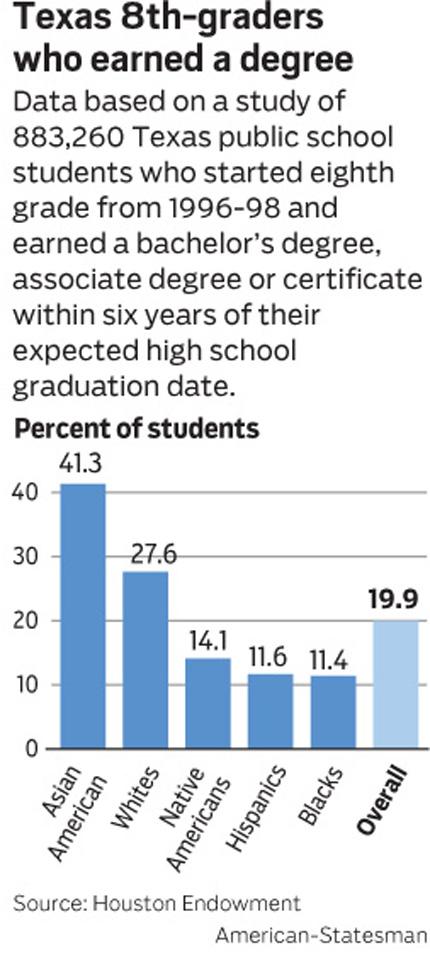
The study was conducted for the Houston Endowment by the National Center for Higher Education Management Systems, a private nonprofit based in Boulder, Colo. Using data from the Texas Higher Education Coordinating Board and other sources, researchers tracked the educational trajectory of all 883,260 public school students in Texas who started eighth grade in 1996, 1997 and 1998.
After 11 years, 19.9 percent had earned a bachelor's degree, associate degree or certificate. There is leakage throughout the education pipeline, as students drop out of high school or college.
Thus far, the study said, only one other state has generated comparable data: Florida, where 17.2 percent of eighth-graders earned a credential. A national study conducted 10 years ago came up with an estimate of 29.3 percent.
Credential-earning rates in Texas varied considerably among racial and ethnic groups, with Asian Americans at 41.3 percent, whites at 27.6 percent, Native Americans at 14.1 percent, Hispanics at 11.6 percent and blacks at 11.4 percent. Higher education specialists say such disparities arise from various factors.
"Three overarching predictors are level of a parent's education, the rigor of the high school years and family income," said George Grainger, director of planning and research for the Houston Endowment.
The study also found disparities by gender, with female students earning a credential at the rate of 23.9 percent and male students at the rate of 16.1 percent. The breakdown ranged from 7.7 percent for black males to 46.5 percent for Asian American females.
The data do not account for so-called interstate mobility: Some students moved and earned a credential in another state. Researchers estimated that this adds 2 percentage points, for an overall credential-earning rate of 21.9 percent.
Texas has taken a number of steps in recent years in an effort to improve its public schools and higher education institutions, including adoption of various accountability measures for the former and a "Closing the Gaps by 2015" plan for the latter.
But progress has been slow on a number of fronts, such as getting the best leaders and teachers into the schools with the most students at risk of academic failure, Grainger said. And many higher education institutions don't take developmental, or remedial, education very seriously, Faulkner said.
Moreover, there is an overarching question of resources for addressing the issue: The state Legislature last year cut funding sharply for public schools, higher education and student financial aid even as enrollment is surging.
Sixteen educational, charitable and business organizations have endorsed the Houston Endowment-commissioned study as both accurate and significant in highlighting a key measure of educational effectiveness.
The findings are "disturbing," said Bill Hammond, president and CEO of the Texas Association of Business. "The report confirms what we know: The public education system across the board is not producing results necessary for Texas to remain competitive, whether it's (kindergarten to 12th grade) or community colleges and beyond."
John Fitzpatrick, executive director of Educate Texas, an initiative of the Dallas-based Communities Foundation of Texas, said he found the credential-earning rates surprisingly low. He noted that public school and higher education officials often point fingers of blame at each other but that this study, by covering the continuum of education, shows the overarching challenge facing the state.
The coordinating board has done a similar analysis for a number of years that tracks seventh-grade students, said Dominic Chavez, a spokesman for the agency.
Houston Endowment officials said many states don't start collecting the relevant data until the eighth grade. They said the organization is committed to issuing an annual report "for the foreseeable future," perhaps broadening it to include other states as their information becomes available.
Education cuts protested at Capitol rally
By Ralph K.M. Haurwitz | AMERICAN-STATESMAN STAFF
March 24, 2012
Sherry Dana's reason for joining a rally protesting cuts in public education spending was summed up by a quote from the Italian poet Dante on a cloth bag slung over her shoulder:
"The hottest places in hell are reserved for those who, in times of great moral crisis, maintain their neutrality."
As far as the retired Austin teacher is concerned, this is no time for neutrality.
"We want kids to be educated," she said. "It makes this a better country."
Leaders of the Save Texas Schools coalition said more than 4,500 teachers, administrators, students and parents from across the state participated in Saturday's rally at the Capitol and march leading up to it. Capitol police estimated the turnout at 1,000. Either way, the crowd was energetic and peaceful under mostly blue, sunny skies.
A coalition rally last spring drew thousands more because of heightened interest during one of the Legislature's regular sessions, which take place in odd-numbered years. But the Republican-led Legislature, grappling with a gaping budget hole, wasn't dissuaded from reducing by $4 billion the amount owed to school districts in the two-year budget.
Lawmakers sliced an additional $1.3 billion from grant programs, including full-day pre-kindergarten and help for students struggling to pass high-stakes standardized tests.
Speakers and attendees at Saturday's rally said the way to turn things around is by voting out the budget-cutters. They stopped short of endorsements but occasionally criticized Republicans in general and GOP Gov. Rick Perry in particular.
"Cutting school funds is a Perry bad idea," read one sign.
The cuts have forced many school districts, including Austin's, to trim payrolls. Statewide, districts have 25,286 fewer employees this year than last year, including 10,717 fewer teachers, said Debbie Ratcliffe, a spokeswoman for the Texas Education Agency.
Hundreds of districts have sued the state, challenging the constitutionality of the school finance system.
The Save Texas Schools coalition wants lawmakers to restore funding and limit what it considers excessive standardized testing. The coalition also wants funding restored for higher education, which saw a reduction of nearly $1 billion.
"We just have to get them to do the right thing," said Carolyn Bruton, a librarian in San Antonio. "The right thing is to make sure each child has an equal education with the right funding."
State Sen. Kirk Watson, D-Austin, said it's important to send a message "to those in control of the state" that many middle-class people believe "Texas can do better."
One of those in control, the governor, told the American-Statesman last month that the state is spending plenty on public education. "The issue is, are we spending enough money in the right places? Are we getting a good return on our investment?" Perry said.
Proponents of limited government spending said Texas should stay in belt-tightened mode.
"I'm confident that further cuts can be made without adversely affecting student performance or without adversely impacting students or teachers," said Peggy Venable, Texas director of Americans for Prosperity.
Thursday, March 1, 2012
Lawmakers, Texans focus on school funding
This is just a start. We can study adequate funding all we want but at the end of the day it boils down to who is going to be there to fight and ensure that what we know needs to be invested is budgeted for. This is not just the responsibility of the people but of legislators that go into communities campaigning on education yet expend very little capital taking on the hard issues when they're on the table.
On September 24, 2011 at the Texas Tribune Festival there was a panel called "How to Pay for Public Education" where a very important exchange between Senator Dan Patrick (co-chair of the Senate Public Education Committee) and Representative Scott Hochberg (co-chair of the House Committee on Public Education). That conversation went something like this:
In this framing, questions such as where, or to who, public education dollars are going to can now be part of the discussion. Many of you who are familiar with the House Public Education hearing on House Bill 500 during last year's session know that Rep. Hochberg was trying to air some of this out.
A lot to unpack when it comes to these issues, friends.
-Patricia
by Gary Scharrer | San Antonio Express-News
02/29/2012
Lt. Gov. David Dewhurst and House Speaker Joe Straus, R-San Antonio, announced the creation of a joint interim committee to study the public school finance system, which likely will be meeting later this year as a state district court hears another school finance lawsuit.
The committee, created through Senate Bill 1 last summer, will study the state’s public school finance system and make recommendations to the 83rd Legislature, which will meet starting in January.
In a statement, Dewhurst said: “The future of Texas is being forged in our classrooms every day. That is why the Texas Legislature remains dedicated to continuing our investment in public education, directing more resources to the classroom and improving the quality of learning for every student in every school and every district across our state.”
Straus said: “Nothing will make a greater difference in the future of our state than the willingness of all Texans to put education first and truly make it our top priority in Texas, and I’m pleased to appoint members to this Select Committee to do so.”
Critics, however, contend that lawmakers have not made public education a priority. The GOP-controlled Legislature last year cut $5.4 billion from public education, which public schools would have gotten under existing law.
A Save Texas Schools rally featuring parents, teachers and students is scheduled March 24 at the Capitol.
“Statewide we’ve seen larger class sizes, lack of instructional materials, and loss of programs to help struggling students succeed,” said Linda Bridges, Texas AFT president. “Parents, students and teachers on March 24 will again send a loud message that we plan to fight for our kids and that we can do better for them and our state’s future. Last year we gathered by the thousands to protest these cuts but were rebuffed by some politicians who claimed that schools would do just fine, that the planned cuts would be absorbed outside the classroom. That story line didn’t fool us then, and it doesn’t wash now as we look at what thousands of school employees and hundreds of superintendents have told us in surveys.”
Sen. Leticia Van de Putte, D-San Antonio, will seve on the committee. Van de Putte’s district includes the Edgwood ISD, which is the name plaintiff in the 1984 landmark school finance case.
“I’ve had to learn a thing or two about school finance. I’ll be glad to put that knowledge to good use,” Van de Putte said.
“It is my sincere hope that this interim’s committee will take meaningful action, rather than simply going through the appearance of acting for our public schools and waiting for the courts to tell us what to do,” Van de Putte said. “We must not just have more conversations about how we fund our schools. We need solutions. What we are doing now is not working and, for our students’ sake, we cannot waste any more time.”
About 92 percent of respondents in a recent Texas AFT survey noted layoffs in their district, with a large percentage reporting loss of teachers (85 percent) and teacher assistants (79 percent). A subsequent survey of 241 superintendents released in January reported actual numbers of layoffs, indicating the loss of more than 30,000 teachers and other school employees statewide by conservative estimate.
“This isn’t just about cutting band trips or football awards banquets,” Bridges said. “Laying off teachers means cramming more kids into each class and the loss of the individualized attention our diverse population of students requires. Eliminating pre-K grants means that kids don’t get the foundation in learning that they desperately need. Wiping out tutorials and services like the Student Success Initiative means more kids won’t meet increasingly rigorous achievement standards, or will simply drop out altogether.”
Four lawsuits have been filed in recent months by various school groups, alleging the state is shortchanging education.
Dewhurst appointed Sen. Florence Shapiro, R-Plano, as joint chair of the school finance committee. Members include: Sens. Bob Deuell, R-Greenville; Robert Duncan, R-Lubbock; Juan “Chuy” Hinojosa, D-McAllen; Jane Nelson, R-Flower Mound; Dan Patrick,, R-Houston; Kel Seliger, R-Amarillo; Carlos Uresti, D-San Antonio; Royce West, D-Dallas; Tommy Williams, R-The Woodlands and Van de Putte.
Straus appointed Rep. Jimmie Don Aycock, R-Killeen, as joint chair of the committee. The committee members include: Representatives Alma Allen, D-Houston; Rafael Anchia, D-Dallas; Rob Eissler, R-The Woodlands; Ryan Guillen, D-Rio Grande City; Donna Howard, D-Austin; Dan Huberty, R-Houston; Susan King, R-Abilene; Todd Smith, R-Euless; Vicki Truitt, R-Keller; and Mike Villarreal, D-San Antonio.
On September 24, 2011 at the Texas Tribune Festival there was a panel called "How to Pay for Public Education" where a very important exchange between Senator Dan Patrick (co-chair of the Senate Public Education Committee) and Representative Scott Hochberg (co-chair of the House Committee on Public Education). That conversation went something like this:
Sen. Patrick argued that what it costs to educate a student has yet to be defined, especially given the number of "different" students (i.e., 4.8 million students) with "different price tags"
Rep. Hochberg rejected that notion saying that the state had spent $1 million to "study," prior to Sen. Patrick's time, examining what it costs to educate based on those districts that are successful with the kids across the groups that were identified (e.g., low-income group, the kids with different language ability, etc.).
The findings showed that adequate funding and weights were much greater that what the state was currently spending. The legislature's response, according to Rep. Hochberg was: "we [legislators] frankly looked at it and said we don’t have the money to do that."
Rep. Hochberg's following argument was that it's not enough for the state to prioritize putting dollars into education (backhanding Sen. Patrick's comment that public and higher education combined account for 50% of the state budget with a quick "so what!?") but that attention needs to consider how dollars are being prioritized within education.
In this framing, questions such as where, or to who, public education dollars are going to can now be part of the discussion. Many of you who are familiar with the House Public Education hearing on House Bill 500 during last year's session know that Rep. Hochberg was trying to air some of this out.
A lot to unpack when it comes to these issues, friends.
-Patricia
by Gary Scharrer | San Antonio Express-News
02/29/2012
Lt. Gov. David Dewhurst and House Speaker Joe Straus, R-San Antonio, announced the creation of a joint interim committee to study the public school finance system, which likely will be meeting later this year as a state district court hears another school finance lawsuit.
The committee, created through Senate Bill 1 last summer, will study the state’s public school finance system and make recommendations to the 83rd Legislature, which will meet starting in January.
In a statement, Dewhurst said: “The future of Texas is being forged in our classrooms every day. That is why the Texas Legislature remains dedicated to continuing our investment in public education, directing more resources to the classroom and improving the quality of learning for every student in every school and every district across our state.”
Straus said: “Nothing will make a greater difference in the future of our state than the willingness of all Texans to put education first and truly make it our top priority in Texas, and I’m pleased to appoint members to this Select Committee to do so.”
Critics, however, contend that lawmakers have not made public education a priority. The GOP-controlled Legislature last year cut $5.4 billion from public education, which public schools would have gotten under existing law.
A Save Texas Schools rally featuring parents, teachers and students is scheduled March 24 at the Capitol.
“Statewide we’ve seen larger class sizes, lack of instructional materials, and loss of programs to help struggling students succeed,” said Linda Bridges, Texas AFT president. “Parents, students and teachers on March 24 will again send a loud message that we plan to fight for our kids and that we can do better for them and our state’s future. Last year we gathered by the thousands to protest these cuts but were rebuffed by some politicians who claimed that schools would do just fine, that the planned cuts would be absorbed outside the classroom. That story line didn’t fool us then, and it doesn’t wash now as we look at what thousands of school employees and hundreds of superintendents have told us in surveys.”
Sen. Leticia Van de Putte, D-San Antonio, will seve on the committee. Van de Putte’s district includes the Edgwood ISD, which is the name plaintiff in the 1984 landmark school finance case.
“I’ve had to learn a thing or two about school finance. I’ll be glad to put that knowledge to good use,” Van de Putte said.
“It is my sincere hope that this interim’s committee will take meaningful action, rather than simply going through the appearance of acting for our public schools and waiting for the courts to tell us what to do,” Van de Putte said. “We must not just have more conversations about how we fund our schools. We need solutions. What we are doing now is not working and, for our students’ sake, we cannot waste any more time.”
About 92 percent of respondents in a recent Texas AFT survey noted layoffs in their district, with a large percentage reporting loss of teachers (85 percent) and teacher assistants (79 percent). A subsequent survey of 241 superintendents released in January reported actual numbers of layoffs, indicating the loss of more than 30,000 teachers and other school employees statewide by conservative estimate.
“This isn’t just about cutting band trips or football awards banquets,” Bridges said. “Laying off teachers means cramming more kids into each class and the loss of the individualized attention our diverse population of students requires. Eliminating pre-K grants means that kids don’t get the foundation in learning that they desperately need. Wiping out tutorials and services like the Student Success Initiative means more kids won’t meet increasingly rigorous achievement standards, or will simply drop out altogether.”
Four lawsuits have been filed in recent months by various school groups, alleging the state is shortchanging education.
Dewhurst appointed Sen. Florence Shapiro, R-Plano, as joint chair of the school finance committee. Members include: Sens. Bob Deuell, R-Greenville; Robert Duncan, R-Lubbock; Juan “Chuy” Hinojosa, D-McAllen; Jane Nelson, R-Flower Mound; Dan Patrick,, R-Houston; Kel Seliger, R-Amarillo; Carlos Uresti, D-San Antonio; Royce West, D-Dallas; Tommy Williams, R-The Woodlands and Van de Putte.
Straus appointed Rep. Jimmie Don Aycock, R-Killeen, as joint chair of the committee. The committee members include: Representatives Alma Allen, D-Houston; Rafael Anchia, D-Dallas; Rob Eissler, R-The Woodlands; Ryan Guillen, D-Rio Grande City; Donna Howard, D-Austin; Dan Huberty, R-Houston; Susan King, R-Abilene; Todd Smith, R-Euless; Vicki Truitt, R-Keller; and Mike Villarreal, D-San Antonio.
Friday, February 3, 2012
Little Agreement on How to Fix School Finance System
by Ben Philpott | Texas Tribune
February 3, 2012
A teachers group has urged Gov. Rick Perry to call a special session to address education funding, but there's still plenty of disagreement on what fixing the school funding system would actually mean.
Some think lawmakers should eliminate the use of local property taxes and pass a constitutional amendment to create a statewide property tax. Others want a more immediate fix: Spend a couple of billion dollars to stop additional teacher layoffs — and call lawmakers back to Austin to do so.
“State government has the money to do that — it’s taxpayers’ money, called the Rainy Day Fund,” said Rita Haecker, president of the Texas State Teachers Association.
Haecker said at a news conference Wednesday that without that stopgap money, schools could be forced to continue slashing jobs.
“An estimated 32,000 school employees, including 12,000 teachers, already have lost their jobs,” she said.
Bill Peacock with the conservative Texas Public Policy Foundation disagrees. “There are a lot of people calling for a special session, but we don’t see the need for one,” Peacock said.
Peacock said the Rainy Day Fund should only be used for one-time costs, not recurring expenses like teacher salaries. He said adding another patch to the heavily bandaged school finance system won't help anyone.
On that point, the Equity Center, a nonprofit group that advocates for middle- and low-income school districts, agrees. But it's focused on a big-picture fix to the system.
The center's Lauren Cook says lawmakers can do that by simply following the state's current education code.
"It should finance schools in a thorough and efficient way so that all students have the same opportunities,” she said, “and so that taxpayers that pay substantially similar rates are receiving substantially similar revenue in their school districts."
While Cook seeks equity, Peacock and his crew are searching for efficiencies, like letting parents pick the type of education their children receive.
“Vouchers, public school choice, virtual education — with technology these days, there’s a whole lot of things that one could do to improve the efficiency and put more competition into the system of public schools and public education you have in Texas,” Peacock said.
Neither the Texas Public Policy Foundation nor the Equity Center thinks lawmakers will take up major changes to school finance until they are forced to do so by the Texas Supreme Court. And that's not expected until the 2013 legislative session is over.
February 3, 2012
A teachers group has urged Gov. Rick Perry to call a special session to address education funding, but there's still plenty of disagreement on what fixing the school funding system would actually mean.
Some think lawmakers should eliminate the use of local property taxes and pass a constitutional amendment to create a statewide property tax. Others want a more immediate fix: Spend a couple of billion dollars to stop additional teacher layoffs — and call lawmakers back to Austin to do so.
“State government has the money to do that — it’s taxpayers’ money, called the Rainy Day Fund,” said Rita Haecker, president of the Texas State Teachers Association.
Haecker said at a news conference Wednesday that without that stopgap money, schools could be forced to continue slashing jobs.
“An estimated 32,000 school employees, including 12,000 teachers, already have lost their jobs,” she said.
Bill Peacock with the conservative Texas Public Policy Foundation disagrees. “There are a lot of people calling for a special session, but we don’t see the need for one,” Peacock said.
Peacock said the Rainy Day Fund should only be used for one-time costs, not recurring expenses like teacher salaries. He said adding another patch to the heavily bandaged school finance system won't help anyone.
On that point, the Equity Center, a nonprofit group that advocates for middle- and low-income school districts, agrees. But it's focused on a big-picture fix to the system.
The center's Lauren Cook says lawmakers can do that by simply following the state's current education code.
"It should finance schools in a thorough and efficient way so that all students have the same opportunities,” she said, “and so that taxpayers that pay substantially similar rates are receiving substantially similar revenue in their school districts."
While Cook seeks equity, Peacock and his crew are searching for efficiencies, like letting parents pick the type of education their children receive.
“Vouchers, public school choice, virtual education — with technology these days, there’s a whole lot of things that one could do to improve the efficiency and put more competition into the system of public schools and public education you have in Texas,” Peacock said.
Neither the Texas Public Policy Foundation nor the Equity Center thinks lawmakers will take up major changes to school finance until they are forced to do so by the Texas Supreme Court. And that's not expected until the 2013 legislative session is over.
Teachers seek special session to stop school cuts
Gary Scharrer | Houston Chronicle
February 1, 2012
Gov. Rick Perry should call Texas legislators back to the Capitol for a special session to spare more public school cuts next year now that the economic recovery is producing more revenue than expected, a teachers group said Wednesday.
The state ended the 2011 budget year with a $1.1 billion surplus, Rep. Donna Howard, D-Austin, noted and the current budget cycle is expected to produce another $1.6 billion surplus.
Perry should ask lawmakers to tap into the state’s $7.3 billion rainy day fund to avoid more school layoffs and larger class sizes next year, Howard and Texas State Teachers Association President Rita Haecker said.
The Republican-controlled Legislature last year cut $5.4 billion from public education for the current two-year budget, which forced school districts to cut about 32,000 school employees, including 12,000 teachers, Haecker said.
More than 8,200 elementary classes are larger than the cap set by state law.
“It is time to stop the bleeding and stop the cuts, now,” she said.
There’s little likelihood that Perry will call legislators into a special legislative cuts to spare more school cuts next year.
“There are no plans to call a special session on this or any other issue. Thanks to Gov. Perry’s fiscally conservative leadership Texas has a balanced budget and has increased funding to Texas public schools by billions of dollars,” Perry spokeswoman Allison Castle said.
Howard passed an amendment last year that would have sent money to school districts to help fund the annual 80,000-student enrollment increase if the Rainy Day Fund passed a certain threshold. But the amendment got stripped from the final bill.
The willingness to cut more education funding instead of using surplus tax revenue will become a campaign issue this year, both Haecker and Howard said.
“We need to hear from parents across the state,” Howard said.
The state’s future workforce and economic develop hinge on a better education population, both Howard and Haecker said.
Education cuts, they said, send a wrong message about the priority of education.
“You can sense in our community their frustration and anger. You will see their willingness to take a role in changing the outcome of this,” Haecker said.
The Texas State Teachers Association will be circulating petitions, urging Perry to call a special session.
February 1, 2012
Gov. Rick Perry should call Texas legislators back to the Capitol for a special session to spare more public school cuts next year now that the economic recovery is producing more revenue than expected, a teachers group said Wednesday.
The state ended the 2011 budget year with a $1.1 billion surplus, Rep. Donna Howard, D-Austin, noted and the current budget cycle is expected to produce another $1.6 billion surplus.
Perry should ask lawmakers to tap into the state’s $7.3 billion rainy day fund to avoid more school layoffs and larger class sizes next year, Howard and Texas State Teachers Association President Rita Haecker said.
The Republican-controlled Legislature last year cut $5.4 billion from public education for the current two-year budget, which forced school districts to cut about 32,000 school employees, including 12,000 teachers, Haecker said.
More than 8,200 elementary classes are larger than the cap set by state law.
“It is time to stop the bleeding and stop the cuts, now,” she said.
There’s little likelihood that Perry will call legislators into a special legislative cuts to spare more school cuts next year.
“There are no plans to call a special session on this or any other issue. Thanks to Gov. Perry’s fiscally conservative leadership Texas has a balanced budget and has increased funding to Texas public schools by billions of dollars,” Perry spokeswoman Allison Castle said.
Howard passed an amendment last year that would have sent money to school districts to help fund the annual 80,000-student enrollment increase if the Rainy Day Fund passed a certain threshold. But the amendment got stripped from the final bill.
The willingness to cut more education funding instead of using surplus tax revenue will become a campaign issue this year, both Haecker and Howard said.
“We need to hear from parents across the state,” Howard said.
The state’s future workforce and economic develop hinge on a better education population, both Howard and Haecker said.
Education cuts, they said, send a wrong message about the priority of education.
“You can sense in our community their frustration and anger. You will see their willingness to take a role in changing the outcome of this,” Haecker said.
The Texas State Teachers Association will be circulating petitions, urging Perry to call a special session.
Thursday, February 2, 2012
Texas Schools Chief's Remarks on Testing Draw Backlash
by Morgan Smith | Texas Tribune
2/1/2012
Some high-profile members of the education community aren't pleased with Texas Education Agency Commissioner Robert Scott's speech on Tuesday criticizing the role of testing in Texas public schools.
Speaking to 4,000 school officials at the Texas Association of School Administrators' annual midwinter conference, Scott received a standing ovation when he called for an accountability system that measured "what happens on every single day in the life of a school besides testing day." He also said that he would not certify a ban on social promotion next year unless schools received more money from the state to offer remedial classes to students.
Uncertainty about student performance on the rigorous new state STAAR exams has caused concern across the state as schools also grapple with a $5 billion-plus reduction in state funding that lawmakers enacted during the last legislative session.
"I think he owes all of the legislators an explanation of his comments," said state Sen. Florence Shapiro, R-Plano, a chief architect of the legislation that created STAAR. Shapiro, the chairwoman of the Senate Education Committee, said she was "blown away" by the commissioner's remarks in light of his repeated testimony during the legislative session that schools would have enough money to move forward with STAAR.
"That's a direction I've never heard him take," she said, adding, "He's been the one that's been talking about school accountability over the years. We've all been a part of this. School accountability is something we started many, many years ago, and we believe in it."
During a House Public Education Committee hearing last week on the STAAR implementation, parents and school leaders expressed concern about a lack of clarity surrounding the exams' various requirements, with some going so far as to ask for a delay in tests' consequences for students.
But that will not happen without a fight. The Texas Association of Business, the state's largest business group, plans to take out a full-page ad in tomorrow's Austin American-Statesman urging lawmakers not to postpone the rollout of the exams. In an interview, Bill Hammond, the group's president and a fierce accountability advocate, blasted Scott, who also said the state's testing system had become a "perversion of its original intent."
Calling Scott a "cheerleader for mediocrity," Hammond said that the fact that the state was forced to reduce funding to education was not a reason to retreat on accountability standards for schools.
"Every time we've gone through this, the standard has been met, and it has resulted in a better educated work force," Hammond said. "I do not understand Commissioner Scott's making excuses for the educators."
The Tribune has made a call to Scott for comment.
2/1/2012
Some high-profile members of the education community aren't pleased with Texas Education Agency Commissioner Robert Scott's speech on Tuesday criticizing the role of testing in Texas public schools.
Speaking to 4,000 school officials at the Texas Association of School Administrators' annual midwinter conference, Scott received a standing ovation when he called for an accountability system that measured "what happens on every single day in the life of a school besides testing day." He also said that he would not certify a ban on social promotion next year unless schools received more money from the state to offer remedial classes to students.
Uncertainty about student performance on the rigorous new state STAAR exams has caused concern across the state as schools also grapple with a $5 billion-plus reduction in state funding that lawmakers enacted during the last legislative session.
"I think he owes all of the legislators an explanation of his comments," said state Sen. Florence Shapiro, R-Plano, a chief architect of the legislation that created STAAR. Shapiro, the chairwoman of the Senate Education Committee, said she was "blown away" by the commissioner's remarks in light of his repeated testimony during the legislative session that schools would have enough money to move forward with STAAR.
"That's a direction I've never heard him take," she said, adding, "He's been the one that's been talking about school accountability over the years. We've all been a part of this. School accountability is something we started many, many years ago, and we believe in it."
During a House Public Education Committee hearing last week on the STAAR implementation, parents and school leaders expressed concern about a lack of clarity surrounding the exams' various requirements, with some going so far as to ask for a delay in tests' consequences for students.
But that will not happen without a fight. The Texas Association of Business, the state's largest business group, plans to take out a full-page ad in tomorrow's Austin American-Statesman urging lawmakers not to postpone the rollout of the exams. In an interview, Bill Hammond, the group's president and a fierce accountability advocate, blasted Scott, who also said the state's testing system had become a "perversion of its original intent."
Calling Scott a "cheerleader for mediocrity," Hammond said that the fact that the state was forced to reduce funding to education was not a reason to retreat on accountability standards for schools.
"Every time we've gone through this, the standard has been met, and it has resulted in a better educated work force," Hammond said. "I do not understand Commissioner Scott's making excuses for the educators."
The Tribune has made a call to Scott for comment.
Monday, January 9, 2012
There's got to be a better way to finance education
Houston Chronicle
Friday, January 6, 2012
The state of Texas is facing multiple lawsuits over school finance as it heads into the New Year.
It's not as if the litigation was totally unexpected.
School district administrators from across the state were in Austin last legislative session begging the Legislature to address the woefully inadequate public school finance situation.
Not only did state lawmakers fail to address the problems, they cut $5.3 billion from public education and failed to provide additional funding for the 80,000 new students who are added to the school rolls each year.
There is something fundamentally wrong with the way the state conducts business if school districts are regularly forced to spend their money to take the state to court to do right by schoolchildren.
The latest flurry of lawsuits against the state over school finance is the sixth time the issue has landed in court since the 1989 Texas Supreme Court ruling in the landmark Edgewood v. Kirby lawsuit.
The first lawsuit filed this time around was brought by low- and medium-wealth districts that contend the state's funding formula is inequitable.
The second suit was filed by higher-wealth districts that claim the Legislature has failed to adequately fund public education.
The third lawsuit, filed by the Mexican American Legal Defense and Education Fund, contends the state's public education funding system is inequitable for all students and inadequate for English-language learners and low-income students.
And the state's largest school districts filed the fourth lawsuit.
It is unfortunate taxpayers have had to resort to taking state officials to court to fix the problem.
State lawmakers have known for years that the 2006 so-called margins tax, which allowed a broad-based business tax to replace property taxes, was not working, but they did nothing about it.
They allowed the shortfall in revenue to expand until it prompted heavy cuts in public education and forced thousands of teacher layoffs, staff cuts and reductions in many programs.
In the process, many school districts have been forced to set their property tax rates at the maximum allowed by law just to be able to balance this budget.
The state keeps setting the accountability bar higher and higher for public education but cuts funding. State officials boast they were able to balance the state budget without raising taxes, but in doing so they forced school districts to finance lawsuits to take the state to court to get it to do the right thing.
It is unfair and unjust.
Friday, January 6, 2012
The state of Texas is facing multiple lawsuits over school finance as it heads into the New Year.
It's not as if the litigation was totally unexpected.
School district administrators from across the state were in Austin last legislative session begging the Legislature to address the woefully inadequate public school finance situation.
Not only did state lawmakers fail to address the problems, they cut $5.3 billion from public education and failed to provide additional funding for the 80,000 new students who are added to the school rolls each year.
There is something fundamentally wrong with the way the state conducts business if school districts are regularly forced to spend their money to take the state to court to do right by schoolchildren.
The latest flurry of lawsuits against the state over school finance is the sixth time the issue has landed in court since the 1989 Texas Supreme Court ruling in the landmark Edgewood v. Kirby lawsuit.
The first lawsuit filed this time around was brought by low- and medium-wealth districts that contend the state's funding formula is inequitable.
The second suit was filed by higher-wealth districts that claim the Legislature has failed to adequately fund public education.
The third lawsuit, filed by the Mexican American Legal Defense and Education Fund, contends the state's public education funding system is inequitable for all students and inadequate for English-language learners and low-income students.
And the state's largest school districts filed the fourth lawsuit.
It is unfortunate taxpayers have had to resort to taking state officials to court to fix the problem.
State lawmakers have known for years that the 2006 so-called margins tax, which allowed a broad-based business tax to replace property taxes, was not working, but they did nothing about it.
They allowed the shortfall in revenue to expand until it prompted heavy cuts in public education and forced thousands of teacher layoffs, staff cuts and reductions in many programs.
In the process, many school districts have been forced to set their property tax rates at the maximum allowed by law just to be able to balance this budget.
The state keeps setting the accountability bar higher and higher for public education but cuts funding. State officials boast they were able to balance the state budget without raising taxes, but in doing so they forced school districts to finance lawsuits to take the state to court to get it to do the right thing.
It is unfair and unjust.
Thursday, January 5, 2012
UT-Austin Prepares for Fight Over Tuition Increases
by Reeve Hamilton | Texas Tribune
January 5, 2011
A group of students taking their cues from the Occupy movement wants the University of Texas System regents to know they won’t take tuition increases without a fight.
At a meeting in front of UT’s iconic tower tonight, the students will settle on a final version of a protest document they hope sparks a larger pushback against the growing cost of higher education.
If 2011 was a rough year for higher education, and UT in particular, the burgeoning Occupy UT group — which takes its name and inspiration from the worldwide phenomenon that began last year — might be an indication that 2012 may not be any easier. One assured flashpoint: how and how high tuition is set.
Forces on both the left and right of the political spectrum are already preparing for battle.
Toward the end of 2011, UT President Bill Powers concurred with recommendations from the university’s Tuition Policy Advisory Committee, made up of students, faculty and administrators, to ask the University of Texas System Board of Regents to increase tuition by 2.6 percent each of the next two years. That’s the maximum the regents, who will make the final tuition decision later this year, said they’d allow.
Adopting the recommendations will mean an extra $127 for in-state students in the coming academic year and $131 in the next. Leaders at UT argue that increases are necessary to avoid immediate cuts to crucial programs.
Not every university in Texas intends to increase tuition next year — the University of Texas at Arlington is a notable example — but it certainly is the trend. And the opposition UT faces from students and others who oppose the price hikes is illustrative of tuition struggles statewide.
Natalie Butler, the UT student body president and a member of the tuition advisory committee, said she hoped the increases would buy the university time to reconsider its approach to funding. “The fact that this current model is not sustainable is not lost on anyone, myself included,” she said.
When the committee’s recommendations were released following a closed-door meeting, many in right-leaning circles that spent much of last year questioning UT’s efficiency and transparency began crying foul. On the conservative Empower Texans blog, writer Will Lutz questioned if the process had violated recent legislative efforts to increase the transparency of the decision-making process regarding student fees. He concluded that while no open-records laws may have been broken, the committee was “ignoring both the intent and spirit” of recent legislation.
UT officials argue that as an advisory body that does not make final decisions on tuition, the committee can meet behind closed doors, allowing members to speak more freely.
Meanwhile, the ostensibly nonpartisan but generally left-leaning members of the nascent Occupy UT movement attended the advisory committee meeting following the announcement of the recommendations to chant their complaints about the proposed increases and the process that led to them.
“We know that this forum is a mere formality,” dozens of students stood up and shouted. “We know that this forum was never a chance to democratically participate in this decision-making process.”
UT President Powers later told the student newspaper The Daily Texan, “I thought the comments were very constructive. It was an interesting theatrical way to make a point. … It doesn’t surprise me that there’s not unanimous agreement on this across the University.”
Trevor Hoag, an assistant instructor at UT and an Occupy UT participant, said — speaking for himself, not the group — that he believes administrators are in “a tight spot” due to state budget cuts. And he said he wants to believe that they are more like-minded than it might seem at first blush. But, Hoag said, “If you’re really standing with us, then what would be the perfect rebuke to the Legislature than to say, ‘You’re going to cut us, but we’re not going to raise tuition. We’re going to buck the trend.’”
The Occupy students’ draft statement catalogs a list of grievances with the university: tuition increases “such that lower- and middle-class students can no longer afford to attend”; students accruing massive student loan debt, “which has led to wide-spread bankruptcy and default”; and an administration that “has leveled no serious rebuke against the legislature of the State of Texas” by demanding the re-regulation of tuition and a return to previous funding levels.
The students also complain that UT has made those decisions, among others, “with practically no democratic input from students, and it will continue to do so until students unite in order to turn the tide.”
Kevin Hegarty, UT’s vice president and chief financial officer, disagreed. He said the opportunities for student involvement in tuition recommendations had increased — the tuition advisory committee held open forums prior to its decision, and several new student budget advisory committees have been established in the last year — but overall student participation had not. “The vast majority of the student body does not seem to want to engage in that particular discussion, but that said, we’ll continue to make the effort,” he said.
Butler, the student body president, agreed, saying she had expected to hear calls to prevent tuition increases at two open advisory committee meetings before the recommendations were finalized. “I was expecting it and didn’t hear it, and that colored my thinking of things,” she said.
Now, the tuition decision rests with the regents, and it’s likely that they will hear opposition from voices on the right and from Occupiers like Hoag, who said, “We just want, if nothing else, manageable student debt.”
Hoag and his compatriots in Occupy UT have big plans. Thus far their strategy has been more event-based, but a physical occupation could be in the works for later in the semester. And they are reaching out to sympathetic groups at other schools, like Texas State University in San Marcos, which has had a small band of occupiers for months.
“Our target is, in some way, to attract others to swell the movement rather than to plead to the masters for more scraps,” Hoag said.
Tuesday, January 3, 2012
Budget Analysis Documenting the Harm Done in 2011 Legislative Session
CPPP's Budget Analysis Documenting the Harm Done in 2011 Legislative Session:
A new report from the Austin-based Center for Public Policy Priorities updates the damage inventory resulting from state budget cuts forced through the legislature by the governor and legislative leaders last spring and summer. The December 2011 report by analyst Eva DeLuna Castro notes that “the state budget directly eliminates 5,727 public jobs by 2013, while school districts will lose state aid that would have supported 49,000 jobs.” The report further concludes: “After adjusting for inflation, Texas per-student spending will fall to its lowest point in over a decade. The 2012-13 budget assumes that local property taxes will not rise to offset the decrease in state aid.”
Download the full report.
A new report from the Austin-based Center for Public Policy Priorities updates the damage inventory resulting from state budget cuts forced through the legislature by the governor and legislative leaders last spring and summer. The December 2011 report by analyst Eva DeLuna Castro notes that “the state budget directly eliminates 5,727 public jobs by 2013, while school districts will lose state aid that would have supported 49,000 jobs.” The report further concludes: “After adjusting for inflation, Texas per-student spending will fall to its lowest point in over a decade. The 2012-13 budget assumes that local property taxes will not rise to offset the decrease in state aid.”
Download the full report.
Senator grills UT chancellor, an old friend
By Ralph K.M. Haurwitz | AMERICAN-STATESMAN STAFF
Friday, Nov. 18, 2011
State Sen. Judith Zaffirini, D-Laredo, has known Francisco Cigarroa since he was born. His mother is one of her best friends. His father is her physician.
But Cigarroa, the chancellor of the University of Texas System, didn't alert Zaffirini, who leads the Senate Higher Education Committee, when a controversy erupted early this year over the direction of the system and its governing board.
"And when UT was criticized in particular, you didn't defend UT," Zaffirini told Cigarroa at a hearing held Friday by a special House-Senate panel. "Why not?"
Cigarroa replied that he initially was "trying to put my hands around how quickly this was moving and where it was going."
Indeed, he was navigating a political minefield. The chairman of the Board of Regents had hired an adviser — who was later dismissed — with a job description overlapping some of the chancellor's duties. And some UT regents, along with counterparts at the Texas A&M University System, seemed sympathetic to Gov. Rick Perry's desire to shake up public higher education.
Cigarroa testified that he found other venues to speak his mind, including a gathering of prominent donors, newspaper editorial boards and meetings of the regents where he defended the system's faculty members and scolded board members for micromanagement.
"So in my voice," Cigarroa said, "I spoke out to the best of my abilities."
The exchange wasn't the only moment when the senator put her old friend on the spot during Friday's hearing of the Joint Oversight Committee on Higher Education Governance, Excellence and Transparency, which Zaffirini leads along with Rep. Dan Branch , R-Dallas. Up to now, she has largely defended the chancellor's handling of the higher education debate, which broke out in March after Gene Powell, chairman of the UT regents, hired Rick O'Donnell as special adviser and suggested that college costs could be reduced by offering a $10,000 bachelor's degree akin to the quality of a midlevel vehicle .
Zaffirini noted that when her office requested emails and other records about several higher education proposals promoted by Perry, including bonus pay for faculty members based solely on student evaluations, the A&M System "turned in the documents we requested almost immediately. Nothing was marked confidential. Working with UT, on the other hand, whether with the system or with a particular individual, was incredibly challenging.
"I think I called you, chancellor, what, perhaps five times, saying, 'Where is the information and why aren't we getting it?' And so many of the emails were marked confidential," Zaffirini said.
"We haven't found anything that we consider confidential. Embarrassing? Yes. Controversial? Absolutely. Stupid? Sometimes. But not confidential. And even today we have not resolved which are no longer considered confidential. Why is it so difficult and why is this information still being considered confidential?" she said.
Cigarroa replied that he didn't understand why it was so difficult. "I certainly conveyed your strong concerns to the Office of General Counsel," he said. "I think a complicating factor was that we were under threat of ... a lawsuit by the previous special adviser to the board. I wasn't really an expert to determine what was confidential or not from a legal perspective."
The chancellor said he would convey her concerns again to the system's general counsel, Barry Burgdorf .
"The sooner the better," Zaffirini said, "because we have so much information that I can't ask you questions about because they're marked confidential, and that really ties our hands."
Friday, Nov. 18, 2011
State Sen. Judith Zaffirini, D-Laredo, has known Francisco Cigarroa since he was born. His mother is one of her best friends. His father is her physician.
But Cigarroa, the chancellor of the University of Texas System, didn't alert Zaffirini, who leads the Senate Higher Education Committee, when a controversy erupted early this year over the direction of the system and its governing board.
"And when UT was criticized in particular, you didn't defend UT," Zaffirini told Cigarroa at a hearing held Friday by a special House-Senate panel. "Why not?"
Cigarroa replied that he initially was "trying to put my hands around how quickly this was moving and where it was going."
Indeed, he was navigating a political minefield. The chairman of the Board of Regents had hired an adviser — who was later dismissed — with a job description overlapping some of the chancellor's duties. And some UT regents, along with counterparts at the Texas A&M University System, seemed sympathetic to Gov. Rick Perry's desire to shake up public higher education.
Cigarroa testified that he found other venues to speak his mind, including a gathering of prominent donors, newspaper editorial boards and meetings of the regents where he defended the system's faculty members and scolded board members for micromanagement.
"So in my voice," Cigarroa said, "I spoke out to the best of my abilities."
The exchange wasn't the only moment when the senator put her old friend on the spot during Friday's hearing of the Joint Oversight Committee on Higher Education Governance, Excellence and Transparency, which Zaffirini leads along with Rep. Dan Branch , R-Dallas. Up to now, she has largely defended the chancellor's handling of the higher education debate, which broke out in March after Gene Powell, chairman of the UT regents, hired Rick O'Donnell as special adviser and suggested that college costs could be reduced by offering a $10,000 bachelor's degree akin to the quality of a midlevel vehicle .
Zaffirini noted that when her office requested emails and other records about several higher education proposals promoted by Perry, including bonus pay for faculty members based solely on student evaluations, the A&M System "turned in the documents we requested almost immediately. Nothing was marked confidential. Working with UT, on the other hand, whether with the system or with a particular individual, was incredibly challenging.
"I think I called you, chancellor, what, perhaps five times, saying, 'Where is the information and why aren't we getting it?' And so many of the emails were marked confidential," Zaffirini said.
"We haven't found anything that we consider confidential. Embarrassing? Yes. Controversial? Absolutely. Stupid? Sometimes. But not confidential. And even today we have not resolved which are no longer considered confidential. Why is it so difficult and why is this information still being considered confidential?" she said.
Cigarroa replied that he didn't understand why it was so difficult. "I certainly conveyed your strong concerns to the Office of General Counsel," he said. "I think a complicating factor was that we were under threat of ... a lawsuit by the previous special adviser to the board. I wasn't really an expert to determine what was confidential or not from a legal perspective."
The chancellor said he would convey her concerns again to the system's general counsel, Barry Burgdorf .
"The sooner the better," Zaffirini said, "because we have so much information that I can't ask you questions about because they're marked confidential, and that really ties our hands."
Tuesday, December 13, 2011
UT System Launches Online Route to Degree Completion
by Reeve Hamilton | Texas Tribune
December 13, 2011
The University of Texas System is creating a new path to completion for students who attempted but — for whatever reason — have been unable to finish their college degree.
The Finish@UT program, which launched last week, is a selection of UT-System-approved online courses aimed primarily at students between ages 25 and 35 who have already amassed credits toward an undergraduate degree. “Particularly those students who have had various life issues intervene and cannot get to campus on a regular basis,” said Martha Ellis, associate vice chancellor for community college partnerships at the UT System.
So far, three institutions are participating, and each offers a different degree. Students can earn a bachelor of science in university studies degree at UT-Arlington, a bachelor of multidisciplinary studies degree at UT-El Paso or a bachelor of arts in humanities degree at UT-Permian Basin.
Students must apply and be accepted to the institution from which they will ultimately graduate, but once they are in the system, they can take courses from all three.
So far, the program is fairly small. This fall, 18 students were enrolled with the declared intent to graduate at UT-Arlington, 40 at UT-El Paso and 72 at UT-Permian Basin. However, the total course enrollments were significantly higher at each university, which, according to Ellis, indicates “some students are taking more than one class and from more than one institution.”
The Tribune thanks our Supporting Sponsors
This summer, the UT System increased its commitment to developing new options for blended and online learning. UT System Chancellor Francisco Cigarroa’s framework for the future of the system, which was unanimously approved by the board of regents in August, included a $50 million investment in a new Institute of Transformational Learning, which will focus on such issues.
Other institutions in the system have also been investing in online expansion. UT-Arlington, for example, has a deal with Academic Partnerships, a private company owned by Dallas entrepreneur Randy Best that focuses on translating public university programs into online courses.
While somewhat similar in spirit, Ellis said those initiatives are separate from Finish@UT, which has been in development for about two years — one year of planning, followed by another of pilot projects.
In addition to the ability to earn a degree from the highly regarded UT System, Ellis said the primary benefits of the program for students are the flexible scheduling and degree personalization. “We want to know: How can we tailor a degree to get you a quality degree best utilizing the coursework that you’ve taken to date?” she said.
Students need not have begun their studies at a UT System institution, nor do they need to be Texas residents, to participate, and prices vary based on institution. For Texas residents, 12 credits — a full load — will cost roughly $4,448 at UT-Arlington, $2,815 at UT-El Paso and $2,697 at UT-Permian Basin.
While it’s possible that the program could generate revenue at a time of declining state funding, Ellis said that was not the driving force behind the program's conception. “Revenue? Sure, that would be great too,” she said, “but the primary purpose is to meet the needs to the state of Texas with having a trained work force.”
December 13, 2011
The University of Texas System is creating a new path to completion for students who attempted but — for whatever reason — have been unable to finish their college degree.
The Finish@UT program, which launched last week, is a selection of UT-System-approved online courses aimed primarily at students between ages 25 and 35 who have already amassed credits toward an undergraduate degree. “Particularly those students who have had various life issues intervene and cannot get to campus on a regular basis,” said Martha Ellis, associate vice chancellor for community college partnerships at the UT System.
So far, three institutions are participating, and each offers a different degree. Students can earn a bachelor of science in university studies degree at UT-Arlington, a bachelor of multidisciplinary studies degree at UT-El Paso or a bachelor of arts in humanities degree at UT-Permian Basin.
Students must apply and be accepted to the institution from which they will ultimately graduate, but once they are in the system, they can take courses from all three.
So far, the program is fairly small. This fall, 18 students were enrolled with the declared intent to graduate at UT-Arlington, 40 at UT-El Paso and 72 at UT-Permian Basin. However, the total course enrollments were significantly higher at each university, which, according to Ellis, indicates “some students are taking more than one class and from more than one institution.”
The Tribune thanks our Supporting Sponsors
This summer, the UT System increased its commitment to developing new options for blended and online learning. UT System Chancellor Francisco Cigarroa’s framework for the future of the system, which was unanimously approved by the board of regents in August, included a $50 million investment in a new Institute of Transformational Learning, which will focus on such issues.
Other institutions in the system have also been investing in online expansion. UT-Arlington, for example, has a deal with Academic Partnerships, a private company owned by Dallas entrepreneur Randy Best that focuses on translating public university programs into online courses.
While somewhat similar in spirit, Ellis said those initiatives are separate from Finish@UT, which has been in development for about two years — one year of planning, followed by another of pilot projects.
In addition to the ability to earn a degree from the highly regarded UT System, Ellis said the primary benefits of the program for students are the flexible scheduling and degree personalization. “We want to know: How can we tailor a degree to get you a quality degree best utilizing the coursework that you’ve taken to date?” she said.
Students need not have begun their studies at a UT System institution, nor do they need to be Texas residents, to participate, and prices vary based on institution. For Texas residents, 12 credits — a full load — will cost roughly $4,448 at UT-Arlington, $2,815 at UT-El Paso and $2,697 at UT-Permian Basin.
While it’s possible that the program could generate revenue at a time of declining state funding, Ellis said that was not the driving force behind the program's conception. “Revenue? Sure, that would be great too,” she said, “but the primary purpose is to meet the needs to the state of Texas with having a trained work force.”
Monday, December 12, 2011
Measuring the Impact of Historic Texas Education Cuts
by Morgan Smith | Texas Tribune
December 12, 2011
Since well before the 2011 legislative session began, one question has dominated conversations about the state budget cuts to public education: How will they affect public schools?
There are many answers.
In March, the Texas Education Agency will release the official numbers on school district employment for the 2011-12 school year, including job losses. The figures will be a reckoning in some ways — the first time the state will actually measure the affect of a historic reduction in financing. But several groups, including nonprofit organizations and professional associations, and at least one lawmaker, would like to have a better idea before then — to help shape their own policies and in some cases to be able to control how the discussion is framed.
The Texas American Federation of Teachers, the state branch of the national teachers association, recently released a survey that showed that budget cuts had resulted in widespread layoffs and low morale among public school employees. Linda Bridges, the branch’s president, emphasized the strength of the study’s findings, but because it was an online survey, she said, it was “unscientific” in nature.
The KDK-Harman Foundation, a private nonprofit, is working with Children at Risk, an education advocacy group in Houston, to conduct a comprehensive study on how schools are managing with less money. Jennifer Esterline, the foundation’s executive director, said a lack of both quantitative and qualitative information on the effects of the cuts prompted the study, which was expected to cost just over $100,000.
After a statewide assessment, the study will focus on 25 districts chosen to represent an array of schools. The goal is to determine which programs, employees and other costs they have chosen to eliminate and how that is affecting the classroom.
“It will allow us to get really deep into what are the kinds of decisions superintendents are having to make,” Esterline said, from learning to do more with less to choosing which programs and employees to cut.
Rep. Dan Huberty, R-Houston, decided to canvass the state’s 1,000-plus school districts after he heard that one superintendent in his area had laid off several teachers and then rehired them once final state budget cut numbers came out.
Huberty’s office is not planning to release the results of the survey publicly, said Maggie Irwin, Huberty’s legislative director. It is more of a “self-imposed interim project,” Irwin said, to help shape his understanding of the budget cuts.
Lynn Moak, whose school finance consulting firm, Moak, Casey & Associates, has kept track of job-loss estimates since the start of the session, said the figure of layoffs could vary widely by source, depending on which employees are counted.
For instance, if only teachers are included, it may be a much smaller number than if all employees are included, because many districts are trying to cut everywhere except in the classroom. Moak said that depending on their financial status, districts may face the greater bulk of their budget cuts for the 2011-12 school year — which could cushion the numbers districts report this year.
Moak cautioned against overstating the effect of less money in public education.
“It’d be incorrect to characterize it as a huge impact, except in the concept of what does it mean for the future,” he said. “It means the Legislature can cut and will cut money to public education if the circumstances are right.”
December 12, 2011
Since well before the 2011 legislative session began, one question has dominated conversations about the state budget cuts to public education: How will they affect public schools?
There are many answers.
In March, the Texas Education Agency will release the official numbers on school district employment for the 2011-12 school year, including job losses. The figures will be a reckoning in some ways — the first time the state will actually measure the affect of a historic reduction in financing. But several groups, including nonprofit organizations and professional associations, and at least one lawmaker, would like to have a better idea before then — to help shape their own policies and in some cases to be able to control how the discussion is framed.
The Texas American Federation of Teachers, the state branch of the national teachers association, recently released a survey that showed that budget cuts had resulted in widespread layoffs and low morale among public school employees. Linda Bridges, the branch’s president, emphasized the strength of the study’s findings, but because it was an online survey, she said, it was “unscientific” in nature.
The KDK-Harman Foundation, a private nonprofit, is working with Children at Risk, an education advocacy group in Houston, to conduct a comprehensive study on how schools are managing with less money. Jennifer Esterline, the foundation’s executive director, said a lack of both quantitative and qualitative information on the effects of the cuts prompted the study, which was expected to cost just over $100,000.
After a statewide assessment, the study will focus on 25 districts chosen to represent an array of schools. The goal is to determine which programs, employees and other costs they have chosen to eliminate and how that is affecting the classroom.
“It will allow us to get really deep into what are the kinds of decisions superintendents are having to make,” Esterline said, from learning to do more with less to choosing which programs and employees to cut.
Rep. Dan Huberty, R-Houston, decided to canvass the state’s 1,000-plus school districts after he heard that one superintendent in his area had laid off several teachers and then rehired them once final state budget cut numbers came out.
Huberty’s office is not planning to release the results of the survey publicly, said Maggie Irwin, Huberty’s legislative director. It is more of a “self-imposed interim project,” Irwin said, to help shape his understanding of the budget cuts.
Lynn Moak, whose school finance consulting firm, Moak, Casey & Associates, has kept track of job-loss estimates since the start of the session, said the figure of layoffs could vary widely by source, depending on which employees are counted.
For instance, if only teachers are included, it may be a much smaller number than if all employees are included, because many districts are trying to cut everywhere except in the classroom. Moak said that depending on their financial status, districts may face the greater bulk of their budget cuts for the 2011-12 school year — which could cushion the numbers districts report this year.
Moak cautioned against overstating the effect of less money in public education.
“It’d be incorrect to characterize it as a huge impact, except in the concept of what does it mean for the future,” he said. “It means the Legislature can cut and will cut money to public education if the circumstances are right.”
School Finance Expert Leaving Texas Legislature
by Ross Ramsey | Texas Tribune
December 12, 2011
After 20 years, Scott Hochberg is bailing out of the Texas Legislature. He says it’s time. He’ll be 59 when he leaves office a little over a year from now. He won’t have to campaign in a newly drawn legislative district, and he’ll get back his nights and weekends.
He’ll leave a hole in the House. Hochberg, a Houston Democrat who started as a House staff member and won his first election in 1992, is an acknowledged wizard at school finance and has a deep well of experience in education issues.
He plays it down, saying: “Holes in the Legislature are kind of like holes on the beach. They fill up pretty quickly.”
What Hochberg is good at is a couple of the most important issues the Legislature will be tackling when it convenes in January 2013. The state’s school finance system is under siege, with school districts joining lawsuits challenging the distribution of education money and budget writers struggling to keep conflicting promises: to fully finance public schools on the one hand and to hold the line on taxes and spending on the other. On the policy front, the perpetual wrestling match over testing and management and education curriculums continues.
Hochberg managed to be in the middle of things without becoming a high-profile partisan like his colleagues Garnet Coleman, Jim Dunnam and Pete Gallego. He said the changes at the Capitol had more to do with politics than with policy. Education experts have been forming and departing the Legislature for decades. Another one — Sen. Florence Shapiro, R-Plano, who heads the Senate Education Committee — is leaving after this term, too. People like them have always arrived to fill the holes.
The Tribune thanks our Supporting Sponsors
But the nature of the place has changed. It has always had partisans, Hochberg said, but they weren’t encouraged.
“What I used to hear an awful lot is, ‘I can’t vote for that because my district will kill me,’” he said. “Certain subject areas were certainly off the table, but there was also this feeling of if we could all get together on something, then we’re all better off politically.”
“Perhaps now there’s more concern, particularly on the Republican side, with what goes on in the primary,” he said. “If that’s where the cover is being sought, I think Republicans are less likely to seek cover from opposing Democrats and more likely to seek cover from some of the socalled kingmakers on their side.”
He remembers a dentist who used to voice his opinions the old-fashioned way — on paper, mailed with stamps. “Literally, the letters were sometimes in crayon or Magic Marker,” he said, “and they started out, generally, with ‘What are you idiots doing down there?’”
With modern technology, that one dentist could look like an army, sending thousands of emails. “He was the only guy who ever saw them,” Hochberg said. “He didn’t have the ability to send them to 20,000 people with the click of a button.”
“I’m really not sure, from a psychological standpoint, that we’ve figured out how to deal with that, and to give it its appropriate weight,” he said. “What it means is that the loud voices can be far louder.”
The Republicans came after Hochberg in 2003, redrawing his district so that — they thought — he’d get beat by a Republican. He responded by campaigning heavily in apartment complexes filled with adult nonvoters, identifying issues important to them and working to turn out the people he identified as political supporters. He got a higher percentage of the vote in the 2004 election than he got two years earlier and remained safe, until now.
His Republican colleagues in the Legislature came after him again this year, drawing a map that put him and Rep. Hubert Vo, also a Houston Democrat, in the same legislative district. The maps currently in place — drawn by a panel of federal judges in San Antonio — have him on safer ground, at least in the partisan sense. But it’s not his old district.
“I’ve got about half a new district,” Hochberg said of the new political maps. “That’s a lot of people to get out and get to know. It takes a while to learn the street corners, the liquor licenses.”
“I started over once, 10 years ago,” he said of his decision to leave. “I kind of know what that’s like.”
December 12, 2011
After 20 years, Scott Hochberg is bailing out of the Texas Legislature. He says it’s time. He’ll be 59 when he leaves office a little over a year from now. He won’t have to campaign in a newly drawn legislative district, and he’ll get back his nights and weekends.
He’ll leave a hole in the House. Hochberg, a Houston Democrat who started as a House staff member and won his first election in 1992, is an acknowledged wizard at school finance and has a deep well of experience in education issues.
He plays it down, saying: “Holes in the Legislature are kind of like holes on the beach. They fill up pretty quickly.”
What Hochberg is good at is a couple of the most important issues the Legislature will be tackling when it convenes in January 2013. The state’s school finance system is under siege, with school districts joining lawsuits challenging the distribution of education money and budget writers struggling to keep conflicting promises: to fully finance public schools on the one hand and to hold the line on taxes and spending on the other. On the policy front, the perpetual wrestling match over testing and management and education curriculums continues.
Hochberg managed to be in the middle of things without becoming a high-profile partisan like his colleagues Garnet Coleman, Jim Dunnam and Pete Gallego. He said the changes at the Capitol had more to do with politics than with policy. Education experts have been forming and departing the Legislature for decades. Another one — Sen. Florence Shapiro, R-Plano, who heads the Senate Education Committee — is leaving after this term, too. People like them have always arrived to fill the holes.
The Tribune thanks our Supporting Sponsors
But the nature of the place has changed. It has always had partisans, Hochberg said, but they weren’t encouraged.
“What I used to hear an awful lot is, ‘I can’t vote for that because my district will kill me,’” he said. “Certain subject areas were certainly off the table, but there was also this feeling of if we could all get together on something, then we’re all better off politically.”
“Perhaps now there’s more concern, particularly on the Republican side, with what goes on in the primary,” he said. “If that’s where the cover is being sought, I think Republicans are less likely to seek cover from opposing Democrats and more likely to seek cover from some of the socalled kingmakers on their side.”
He remembers a dentist who used to voice his opinions the old-fashioned way — on paper, mailed with stamps. “Literally, the letters were sometimes in crayon or Magic Marker,” he said, “and they started out, generally, with ‘What are you idiots doing down there?’”
With modern technology, that one dentist could look like an army, sending thousands of emails. “He was the only guy who ever saw them,” Hochberg said. “He didn’t have the ability to send them to 20,000 people with the click of a button.”
“I’m really not sure, from a psychological standpoint, that we’ve figured out how to deal with that, and to give it its appropriate weight,” he said. “What it means is that the loud voices can be far louder.”
The Republicans came after Hochberg in 2003, redrawing his district so that — they thought — he’d get beat by a Republican. He responded by campaigning heavily in apartment complexes filled with adult nonvoters, identifying issues important to them and working to turn out the people he identified as political supporters. He got a higher percentage of the vote in the 2004 election than he got two years earlier and remained safe, until now.
His Republican colleagues in the Legislature came after him again this year, drawing a map that put him and Rep. Hubert Vo, also a Houston Democrat, in the same legislative district. The maps currently in place — drawn by a panel of federal judges in San Antonio — have him on safer ground, at least in the partisan sense. But it’s not his old district.
“I’ve got about half a new district,” Hochberg said of the new political maps. “That’s a lot of people to get out and get to know. It takes a while to learn the street corners, the liquor licenses.”
“I started over once, 10 years ago,” he said of his decision to leave. “I kind of know what that’s like.”
Sunday, December 4, 2011
In Another Blow to Public Schools, Hochberg Leaving Legislature
"The House will dearly miss its resident nerd"
This sums it up well.
-Patricia
by Abby Rapoport | Texas Observer
Friday, December 02, 2011
Scott Hochberg was none too happy that everyone called him a nerd. "You can't think of something to call me?" he groused more than once. But it was hard to think of anything else to call the state legislator with his messy white hair, glasses and encyclopedic knowledge of school finance law. In a House chamber of cheerleaders and quarterbacks, he often proved that knowing the facts and doing your homework could actually bring power and influence. As the chairman of the Appropriations Subcommittee on Education and the vice chair of the Public Education Committee, Hochberg seemed a living example of Revenge of the Nerds.
Until last session, when he watched helplessly as the Texas House chose to make unprecedented cuts to public education, and the leadership shut him out of school finance negotiations, making cuts less equitable across the state.
So maybe it's not a huge surprise that today Hochberg announced he won't seek re-election after almost 20 years in the state Legislature.
Hochberg is one of 25 incumbents so far to announce they aren't coming back. But his decision may have the most widespread impact, particularly for education advocates. The funding mechanisms around public schools and universities are mind-boggling complicated and irrational. Hochberg was the undisputed expert on how the laws worked. He often tangled with the Texas Education Agency, following up on how policy was actually getting implemented. He spent much of his time on the floor translating and explaining the rules to less-informed colleagues. Because education has traditionally been a bipartisan area, Hochberg often had Republicans sponsoring his bills in the Senate and supporting him in the House—most notably working with Public Education Committee Chair Rob Eissler, R-The Woodlands.
Last session, however, everything blew up. With an ultraconservative Republican super-majority and a $27 billion budget shortfall, things turned nasty fast. Spectators watched Hochberg's and Eissler's friendship implode as the two men battled on school finance plans.
Hochberg was kept out of the closed door meetings on school finance and ultimately had almost no say in the plan the House backed—a plan that cut the same percentage from all school districts, despite vast funding inequalities. He had little say on the Appropriations Committee, where lawmakers ultimately decided to cut $5.4 billion from public schools. Then, adding insult to injury, the Legislature passed redistricting maps that put Hochberg in a district with fellow Democrat Hubert Vo. While those maps have now been redrawn by federal courts, it's hardly shocking to think Hochberg's downtrodden.
In his announcement, Hochberg writes, "My decision should not be thought of as any commentary on the current political environment, the challenges ahead, or, for that matter, the disappointment of soon having to endure the designated hitter rule when watching hometown Houston baseball."
But regardless of his reason, Hochberg's departure leaves an enormous gap in education expertise—at a time when the Legislature can least afford it. The 82nd legislative session was bleak, but the 83rd will likely be worse. Next time around, lawmakers will actually have to deal with the state's structural deficit and tax-policy problems, which means figuring out a better system to pay for public schools. Meanwhile, they'll probably also have to figure out a new way to distribute money to the schools. School districts across Texas are suing the state in several different lawsuits around both inadequacy and inequity in funding.
Rep. Jimmie Don Aycock, R-Killeen, is clearly the chosen member to take the reins from Hochberg, but it's bound to be a tough job. During the session, it fell to Aycock to try, unsuccessfully, to pass a fiscal matters bill containing school finance language. While Aycock is undoubtedly smart and eager, he's only in his third term. Hochberg had the trust of his colleagues, that he both understood all sides and would explain the policy options fairly.
The House will dearly miss its resident nerd.
This sums it up well.
-Patricia
by Abby Rapoport | Texas Observer
Friday, December 02, 2011
Scott Hochberg was none too happy that everyone called him a nerd. "You can't think of something to call me?" he groused more than once. But it was hard to think of anything else to call the state legislator with his messy white hair, glasses and encyclopedic knowledge of school finance law. In a House chamber of cheerleaders and quarterbacks, he often proved that knowing the facts and doing your homework could actually bring power and influence. As the chairman of the Appropriations Subcommittee on Education and the vice chair of the Public Education Committee, Hochberg seemed a living example of Revenge of the Nerds.
Until last session, when he watched helplessly as the Texas House chose to make unprecedented cuts to public education, and the leadership shut him out of school finance negotiations, making cuts less equitable across the state.
So maybe it's not a huge surprise that today Hochberg announced he won't seek re-election after almost 20 years in the state Legislature.
Hochberg is one of 25 incumbents so far to announce they aren't coming back. But his decision may have the most widespread impact, particularly for education advocates. The funding mechanisms around public schools and universities are mind-boggling complicated and irrational. Hochberg was the undisputed expert on how the laws worked. He often tangled with the Texas Education Agency, following up on how policy was actually getting implemented. He spent much of his time on the floor translating and explaining the rules to less-informed colleagues. Because education has traditionally been a bipartisan area, Hochberg often had Republicans sponsoring his bills in the Senate and supporting him in the House—most notably working with Public Education Committee Chair Rob Eissler, R-The Woodlands.
Last session, however, everything blew up. With an ultraconservative Republican super-majority and a $27 billion budget shortfall, things turned nasty fast. Spectators watched Hochberg's and Eissler's friendship implode as the two men battled on school finance plans.
Hochberg was kept out of the closed door meetings on school finance and ultimately had almost no say in the plan the House backed—a plan that cut the same percentage from all school districts, despite vast funding inequalities. He had little say on the Appropriations Committee, where lawmakers ultimately decided to cut $5.4 billion from public schools. Then, adding insult to injury, the Legislature passed redistricting maps that put Hochberg in a district with fellow Democrat Hubert Vo. While those maps have now been redrawn by federal courts, it's hardly shocking to think Hochberg's downtrodden.
In his announcement, Hochberg writes, "My decision should not be thought of as any commentary on the current political environment, the challenges ahead, or, for that matter, the disappointment of soon having to endure the designated hitter rule when watching hometown Houston baseball."
But regardless of his reason, Hochberg's departure leaves an enormous gap in education expertise—at a time when the Legislature can least afford it. The 82nd legislative session was bleak, but the 83rd will likely be worse. Next time around, lawmakers will actually have to deal with the state's structural deficit and tax-policy problems, which means figuring out a better system to pay for public schools. Meanwhile, they'll probably also have to figure out a new way to distribute money to the schools. School districts across Texas are suing the state in several different lawsuits around both inadequacy and inequity in funding.
Rep. Jimmie Don Aycock, R-Killeen, is clearly the chosen member to take the reins from Hochberg, but it's bound to be a tough job. During the session, it fell to Aycock to try, unsuccessfully, to pass a fiscal matters bill containing school finance language. While Aycock is undoubtedly smart and eager, he's only in his third term. Hochberg had the trust of his colleagues, that he both understood all sides and would explain the policy options fairly.
The House will dearly miss its resident nerd.
Friday, December 2, 2011
Texplainer: Could Universities Undergo Sunset Review?
Great response from Texas Tech: “We have a sunset review; it’s just not called sunset review. Every two years we come down here and try to justify what we’re doing.”
-Patricia
Hey, Texplainer: Could the state’s public universities go through the so-called sunset review process, forcing them to periodically defend their existence to state legislators?
The issue came up at a November hearing of the Joint Oversight Committee on Higher Education Governance, Excellence and Transparency, a group formed earlier this year amid tense debate over the operations of higher education institutions in the state.
A co-chair of the committee, state Sen. Judith Zaffirini, D-Laredo, cited a recommendation from the Texas Public Policy Foundation, a conservative think tank whose higher education proposals she has openly opposed, that was delivered to legislators prior to the recent legislative session. It called for lawmakers to “study the feasibility, the pros, and the cons of placing universities under sunset review.”
Most state agencies go through the high-stakes process every 12 years. Their operations are scrutinized and the Legislature decides whether they should continue to operate. If legislators don't act to keep an agency in sunset alive, it shuts down.
“If the Legislature were to adopt such a recommendation, how would your universities in your system be impacted?” Zaffirini asked a group of university system chancellors who had been invited to testify on matters of governance.
As might be expected, the chancellors didn’t go for the idea.
University of Houston System Chancellor Renu Khator said it was “not doable.” Texas Tech University System Chancellor Kent Hance, a former legislator, said, “We have a sunset review; it’s just not called sunset review. Every two years we come down here and try to justify what we’re doing.”
That the discussion was even occurring surprised some in the higher education community. Michael McClendon, an education policy expert from Vanderbilt University, has been retained by the Texas Coalition for Excellence in Higher Education, an organization that sprang up in opposition to the TPPF’s proposals. He said it struck him as “illogical,” at a time when universities must increasingly look to private dollars to fund their activities, that they might have to do so with the caveat that they might not exist in a few years. “What right-minded donor would give to that organization?”
Lee Jackson, the chancellor of the University of North Texas System, expressed reluctance to proclaim that universities should be exempt from the sunset process — after all, as a state representative in 1979 he had disagreed with the State Bar of Texas that it should be exempted.
Higher education might be different. Usually, Jackson said, when an agency is sunsetted — a nice way of saying shut down — its functions are transferred to another agency. But because of accreditation requirements, among other issues, the students at a university that was eliminated through the sunset review process could not simply or easily be transferred and would most likely be left in the lurch.
“If the question were asked … could the state of Texas use our time better evaluating our progress, I would say yes,” Jackson said.
That’s what the recommendation was driving at, according to Thomas Lindsay, who arrived as director of the TPPF’s Center for Higher Education after the proposal was made. “The idea behind it is pretty common sense,” he said. “As an entity created for and paid for by the taxpayers, it, like all other state entities, should be reviewed.”
The intent was not to shut down the universities, he said, adding that it was “unfortunate” if that was the impression that had been given. And if a sunset process were in place, he does not believe it would shutter universities. “The purpose of education is not something that’s going to go out of style, so it’s not looked at as a way to abolish them,” he said. “If any entity can [defend its existence], institutions of higher education would be those.”
Lindsay said the TPPF is currently examining different ways to review universities as they piece together what will ultimately be their recommendations for the 2013 legislative session.
Those proposals, when they come, will likely be pored over carefully by the higher education community both in Texas and elsewhere. “I think some people look to Texas with befuddlement,” McClendon said. “They understand that the questions being asked there are being asked everywhere, but some of the solutions being raised seem a bit extreme.”
Bottom line: Technically, it's feasible, but university leaders and some higher education experts say it's not realistic.
-Patricia
Hey, Texplainer: Could the state’s public universities go through the so-called sunset review process, forcing them to periodically defend their existence to state legislators?
The issue came up at a November hearing of the Joint Oversight Committee on Higher Education Governance, Excellence and Transparency, a group formed earlier this year amid tense debate over the operations of higher education institutions in the state.
A co-chair of the committee, state Sen. Judith Zaffirini, D-Laredo, cited a recommendation from the Texas Public Policy Foundation, a conservative think tank whose higher education proposals she has openly opposed, that was delivered to legislators prior to the recent legislative session. It called for lawmakers to “study the feasibility, the pros, and the cons of placing universities under sunset review.”
Most state agencies go through the high-stakes process every 12 years. Their operations are scrutinized and the Legislature decides whether they should continue to operate. If legislators don't act to keep an agency in sunset alive, it shuts down.
“If the Legislature were to adopt such a recommendation, how would your universities in your system be impacted?” Zaffirini asked a group of university system chancellors who had been invited to testify on matters of governance.
As might be expected, the chancellors didn’t go for the idea.
University of Houston System Chancellor Renu Khator said it was “not doable.” Texas Tech University System Chancellor Kent Hance, a former legislator, said, “We have a sunset review; it’s just not called sunset review. Every two years we come down here and try to justify what we’re doing.”
That the discussion was even occurring surprised some in the higher education community. Michael McClendon, an education policy expert from Vanderbilt University, has been retained by the Texas Coalition for Excellence in Higher Education, an organization that sprang up in opposition to the TPPF’s proposals. He said it struck him as “illogical,” at a time when universities must increasingly look to private dollars to fund their activities, that they might have to do so with the caveat that they might not exist in a few years. “What right-minded donor would give to that organization?”
Lee Jackson, the chancellor of the University of North Texas System, expressed reluctance to proclaim that universities should be exempt from the sunset process — after all, as a state representative in 1979 he had disagreed with the State Bar of Texas that it should be exempted.
Higher education might be different. Usually, Jackson said, when an agency is sunsetted — a nice way of saying shut down — its functions are transferred to another agency. But because of accreditation requirements, among other issues, the students at a university that was eliminated through the sunset review process could not simply or easily be transferred and would most likely be left in the lurch.
“If the question were asked … could the state of Texas use our time better evaluating our progress, I would say yes,” Jackson said.
That’s what the recommendation was driving at, according to Thomas Lindsay, who arrived as director of the TPPF’s Center for Higher Education after the proposal was made. “The idea behind it is pretty common sense,” he said. “As an entity created for and paid for by the taxpayers, it, like all other state entities, should be reviewed.”
The intent was not to shut down the universities, he said, adding that it was “unfortunate” if that was the impression that had been given. And if a sunset process were in place, he does not believe it would shutter universities. “The purpose of education is not something that’s going to go out of style, so it’s not looked at as a way to abolish them,” he said. “If any entity can [defend its existence], institutions of higher education would be those.”
Lindsay said the TPPF is currently examining different ways to review universities as they piece together what will ultimately be their recommendations for the 2013 legislative session.
Those proposals, when they come, will likely be pored over carefully by the higher education community both in Texas and elsewhere. “I think some people look to Texas with befuddlement,” McClendon said. “They understand that the questions being asked there are being asked everywhere, but some of the solutions being raised seem a bit extreme.”
Bottom line: Technically, it's feasible, but university leaders and some higher education experts say it's not realistic.
Robin Hood an Accepted Reality for Texas Schools
by Morgan Smith | Texas Tribune
December 2, 2011
When David Thompson is asked about Texas’ long history of school finance litigation, he likes to make a Harry Potter analogy.
“There are common characters, common themes, consistent plot thematic issues that run through all the books,” said Thompson, a lawyer. “But every one of them has a specific focus.”
Now, one phrase is conspicuously absent from the discussion: Robin Hood. The state’s practice of collecting portions of property tax revenue from wealthier districts and redistributing it to poorer ones, also known as “recapture,” was a rallying cry for districts challenging the school finance system in a lawsuit that made its way through the courts from 2001 to 2005.
Though Robin Hood has been a political flash point since its inception in 1993, it has now become settled law. After it survived a high-profile effort at repeal during the 2003 legislative session, a decision from the Texas Supreme Court in 2005 “pretty much dashed” any expectation that the law could be overturned, said F. Scott McCown, who presided over the case in the lower courts as a state judge in 2002.
The state received just over $1 billion in payments in 2010 from more than 300 Robin Hood school districts, according to Texas Education Agency data.
By the end of the year, there will most likely be at least three lawsuits filed against the state relating to how it finances public schools, one led by Thompson. But none of the plaintiffs — not even the group formed primarily of school districts that contribute revenue under Robin Hood — have said their goal is to overturn the law.
“We’re not asking to alter or repeal that provision,” said Rickey Dailey, a spokesman for the Texas School Coalition, which represents property-wealthy school districts that send money back to the state.
Dailey said the districts would instead argue that the state has failed to dedicate enough money to public education to meet increasingly strict accountability standards, and that it has created an unconstitutional statewide property tax because it has left them with little choice in how to spend local taxes or whether to raise them.
“We’re all resigned to the fact that, until the state does something to pull the many school districts that are tax-poor to a minimally adequate level, Robin Hood is going to be here,” said David Webb, the chief financial officer of Deer Park, a wealthy district near Houston that has given back about $578 million since the law was enacted.
While wealthy districts may not have chosen to highlight concerns with Robin Hood as a part of their lawsuit, they still struggle with its consequences — and many have devised ways to get around it, like creating private foundations to help support their schools.
Asking voters to approve higher taxes, some of whose receipts go to poorer schools, is “really a nonstarter,” said Superintendent Kevin Brown of San Antonio's Alamo Heights Independent School District, which has given about $300 million of its property tax revenue to the state since 1993.
But districts hoping for a school finance solution beyond Robin Hood will most likely be disappointed, said McCown, who is now the executive director of the Center for Public Policy Priorities, a liberal research group that supports Robin Hood.
“This very court would have to reverse itself,” he said, “and it doesn’t solve anybody’s problem.”
The state needs the money it receives from wealthy school districts to help finance education for the rest, said Pat Forgione, who was superintendent of the Austin Independent School District from 1999 to 2009 and was a chief witness for the districts fighting Robin Hood last time. The Austin district still sends more to the state through Robin Hood than any other. In 2011 those payments will amount to $111 million — more than three times what the second-highest-contributing district, Plano, in Collin County, will give up.
“They don’t know how to deal with Robin Hood because now Robin Hood isn’t just $100 million anymore,” Forgione said of state lawmakers. “It’s hard to give up that.”
December 2, 2011
When David Thompson is asked about Texas’ long history of school finance litigation, he likes to make a Harry Potter analogy.
“There are common characters, common themes, consistent plot thematic issues that run through all the books,” said Thompson, a lawyer. “But every one of them has a specific focus.”
Now, one phrase is conspicuously absent from the discussion: Robin Hood. The state’s practice of collecting portions of property tax revenue from wealthier districts and redistributing it to poorer ones, also known as “recapture,” was a rallying cry for districts challenging the school finance system in a lawsuit that made its way through the courts from 2001 to 2005.
Though Robin Hood has been a political flash point since its inception in 1993, it has now become settled law. After it survived a high-profile effort at repeal during the 2003 legislative session, a decision from the Texas Supreme Court in 2005 “pretty much dashed” any expectation that the law could be overturned, said F. Scott McCown, who presided over the case in the lower courts as a state judge in 2002.
The state received just over $1 billion in payments in 2010 from more than 300 Robin Hood school districts, according to Texas Education Agency data.
By the end of the year, there will most likely be at least three lawsuits filed against the state relating to how it finances public schools, one led by Thompson. But none of the plaintiffs — not even the group formed primarily of school districts that contribute revenue under Robin Hood — have said their goal is to overturn the law.
“We’re not asking to alter or repeal that provision,” said Rickey Dailey, a spokesman for the Texas School Coalition, which represents property-wealthy school districts that send money back to the state.
Dailey said the districts would instead argue that the state has failed to dedicate enough money to public education to meet increasingly strict accountability standards, and that it has created an unconstitutional statewide property tax because it has left them with little choice in how to spend local taxes or whether to raise them.
“We’re all resigned to the fact that, until the state does something to pull the many school districts that are tax-poor to a minimally adequate level, Robin Hood is going to be here,” said David Webb, the chief financial officer of Deer Park, a wealthy district near Houston that has given back about $578 million since the law was enacted.
While wealthy districts may not have chosen to highlight concerns with Robin Hood as a part of their lawsuit, they still struggle with its consequences — and many have devised ways to get around it, like creating private foundations to help support their schools.
Asking voters to approve higher taxes, some of whose receipts go to poorer schools, is “really a nonstarter,” said Superintendent Kevin Brown of San Antonio's Alamo Heights Independent School District, which has given about $300 million of its property tax revenue to the state since 1993.
But districts hoping for a school finance solution beyond Robin Hood will most likely be disappointed, said McCown, who is now the executive director of the Center for Public Policy Priorities, a liberal research group that supports Robin Hood.
“This very court would have to reverse itself,” he said, “and it doesn’t solve anybody’s problem.”
The state needs the money it receives from wealthy school districts to help finance education for the rest, said Pat Forgione, who was superintendent of the Austin Independent School District from 1999 to 2009 and was a chief witness for the districts fighting Robin Hood last time. The Austin district still sends more to the state through Robin Hood than any other. In 2011 those payments will amount to $111 million — more than three times what the second-highest-contributing district, Plano, in Collin County, will give up.
“They don’t know how to deal with Robin Hood because now Robin Hood isn’t just $100 million anymore,” Forgione said of state lawmakers. “It’s hard to give up that.”
Sunday, November 27, 2011
Texas Schools Face New Rules on Financial Hardship
This history behind this legislation is sickening.
-Patricia
by Morgan Smith | Texas Tribune
11/23/2011
The Texas Education Agency has released new guidelines that set tough thresholds for school districts hoping to take advantage of special legal exemptions passed by the Legislature and intended to help schools cope with significant budget cuts.
A school district's declaration of “financial exigency” is necessary to trigger many provisions of Senate Bill 8, including those that allow districts to streamline mid-contract employee terminations and avoid seniority-based layoffs in certain circumstances. The law, passed during the special session, left it up to the Commissioner of Education to establish a minimum standard for such declarations, which were previously largely in the hands of local school boards.
The rules released Wednesday give several scenarios that allow districts to claim financial exigency — but they are so rigorous that it’s likely that only a small number of districts will actually meet the any of the standards, says Jackie Lain, an associate executive director at the Texas Association of School Boards. The conditions include a funding reduction of more than 10 percent per student or more than a 20 percent decrease in its fund balance.
To put that in perspective, the $4 billion reduction to public education funding during the past legislative session has most districts seeing a 6 percent cut during the first year of the biennium and not more than a 9 percent cut in the second year. Districts vary widely in how much they've used of their fund balances, which amount to emergency savings accounts.
"Before SB8 there weren’t any standards for declaring financial exigency and the bill required the commissioner to adopt minimum standards," says Janice Hollingsworth, who is the interim director of the agency's financial audit division.
Among the other conditions are a decline in enrollment by more than 10 percent over the past two years, an unforeseen natural disaster requiring significant expenditures in excess of 15 percent of a district’s yearly budget, and “any other circumstances approved in writing” by the commissioner of education. Hollingsworth says the commissioner maintained some discretion to anticipate any unforeseen circumstances the other conditions didn't account for.
What the new guidelines mean in practice, says Lain, is that districts may be forced to go through more expensive processes to lay off employees, whose salaries typically make up about 80 percent of their annual budgets, instead of being able to take advantage of the more efficient practices lawmakers approved during the session.
“The thresholds seem to be overly high without any explanations,” Lain says. “How the commissioner uses the discretion will determine if the rules are overly prescriptive, or properly restrictive.”
The TEA will have a period of public comment on the rules. Hollingsworth says they are "subject to change" depending on the feedback the agency receives.
-Patricia
by Morgan Smith | Texas Tribune
11/23/2011
The Texas Education Agency has released new guidelines that set tough thresholds for school districts hoping to take advantage of special legal exemptions passed by the Legislature and intended to help schools cope with significant budget cuts.
A school district's declaration of “financial exigency” is necessary to trigger many provisions of Senate Bill 8, including those that allow districts to streamline mid-contract employee terminations and avoid seniority-based layoffs in certain circumstances. The law, passed during the special session, left it up to the Commissioner of Education to establish a minimum standard for such declarations, which were previously largely in the hands of local school boards.
The rules released Wednesday give several scenarios that allow districts to claim financial exigency — but they are so rigorous that it’s likely that only a small number of districts will actually meet the any of the standards, says Jackie Lain, an associate executive director at the Texas Association of School Boards. The conditions include a funding reduction of more than 10 percent per student or more than a 20 percent decrease in its fund balance.
To put that in perspective, the $4 billion reduction to public education funding during the past legislative session has most districts seeing a 6 percent cut during the first year of the biennium and not more than a 9 percent cut in the second year. Districts vary widely in how much they've used of their fund balances, which amount to emergency savings accounts.
"Before SB8 there weren’t any standards for declaring financial exigency and the bill required the commissioner to adopt minimum standards," says Janice Hollingsworth, who is the interim director of the agency's financial audit division.
Among the other conditions are a decline in enrollment by more than 10 percent over the past two years, an unforeseen natural disaster requiring significant expenditures in excess of 15 percent of a district’s yearly budget, and “any other circumstances approved in writing” by the commissioner of education. Hollingsworth says the commissioner maintained some discretion to anticipate any unforeseen circumstances the other conditions didn't account for.
What the new guidelines mean in practice, says Lain, is that districts may be forced to go through more expensive processes to lay off employees, whose salaries typically make up about 80 percent of their annual budgets, instead of being able to take advantage of the more efficient practices lawmakers approved during the session.
“The thresholds seem to be overly high without any explanations,” Lain says. “How the commissioner uses the discretion will determine if the rules are overly prescriptive, or properly restrictive.”
The TEA will have a period of public comment on the rules. Hollingsworth says they are "subject to change" depending on the feedback the agency receives.
For-Profit, Alternative Teaching Programs Are Booming
Reps. Villarreal and Eissler get to the core of why there's such a "boom" in for-profit teaching programs: for-profit, monied interests strong arm those who would want anything otherwise. If you undermine pre-service teachers' access to curriculum, don't be surprised when they struggle in the classroom.
In Texas, where certain outspoken parents oppose racialized histories out of fear of "indoctrination", they should be asking how these teachers that draw primarily from personal experience void of any preparation on how to create a learning process that allows students to develop their own voices and identities is anything different.
-Patricia
by Morgan Smith and Nick Pandolfo, The Hechinger Report
November 27, 2011
DENTON — One afternoon in mid-November, Jeff Arrington scattered 80 paper gingerbread men labeled with numbers across the floor of his high school disaster-response class.
The numbers corresponded with the severity of injuries ranging from burns to hysterical blindness. His students had to categorize the “men” based on the level of medical attention each required.
Arrington, in the middle of his third month of teaching at the Advanced Technology Complex in the Denton Independent School District, has a background well suited to the subject. He was a police officer for six years — he turned in his badge on Sept. 12 and began teaching the next day.
He is earning his teaching certificate through an online, for-profit alternative certification program, a nontraditional route to teaching that is becoming more common in Texas. Such programs, which can offer certification in three months to two years, are booming despite little more than anecdotal evidence of their success. They draw candidates like Arrington who bring valuable life experience, but there are concerns about how they will perform as teachers, especially since they are more likely to end up in poor districts teaching students in challenging situations.
More than 110 alternative certification programs — including iteachTEXAS, which Arrington is completing, and nonprofits like Teach for America — produce 40 percent of all new teachers in Texas, according to an analysis of Texas Education Agency data by Ed Fuller, a Penn State University education professor and former University of Texas researcher.
For-profit programs dominate that market: Every year since 2007, the two largest companies, A+ Texas Teachers and iteachTEXAS, have produced far more teachers than any other traditional or alternative program. While virtually all paths to the classroom have seen declines since 2003, according to Fuller’s analysis, for-profit alternative certification programs have grown by 23 percent. (While the percentage has increased, the actual number of for-profit alternative certificates granted has decreased since the 2009 economic recession.)
Other states have begun allowing for-profits to enter the alternative teacher training market, but Texas has done so to the greatest extent, according to Emily Feistritzer, president of the National Center for Alternative Certification. Earlier this year, New York began permitting private entities like the American Museum of Natural History and Teach for America to grant teaching certificates and master’s degrees, but they are nonprofits. Some states, like Illinois, require that any alternative routes to the classroom be connected to the university system.
IteachTEXAS, begun in 2003, is the first for-profit, non-university based alternative certification program to expand across state lines, with the newly created iteachU.S. operating programs in Louisiana and Tennessee. Additional offshoots will soon come to Michigan and at least two other states.
Diann Huber, president of iteachU.S., said the program’s goal is to provide a new career opportunity for people who have been laid off in other industries, like auto workers in Michigan, who may be able to use their knowledge to teach high-need subjects like math and science.
Texas began experimenting with alternative certification programs in the mid-1980s. Then, the state “didn’t regulate who was operating private programs, and people saw that was a way to make a fast buck,” said Rae Queen, the president of the Texas Alternative Certification Association, who also runs a for-profit alternative certification program in San Antonio. Queen said the state now has a much more rigorous application and audit process for certification programs. In 2008, the state also instituted a minimum grade-point average of 2.5 for all teaching candidates.
Still, Queen said the reputation of for-profit programs suffers. “There are some companies out there that say ‘you want to be a teacher, start today,’” she said, “and they’ve done that through their own advertising campaigns.”
Some traditional educators believe that for-profits, which typically charge around $4,000 for a program leading to certification, accept applicants with little regard for demand or how they might perform in the classroom. “The for-profits will take anyone,” said Nell Ingram, director of the Dallas Independent School District alternative certification program, adding that her program will not offer courses in subjects that are not in demand.
Principals offer mixed reviews of teachers hired from for-profit programs. Most say those teachers succeed in the classroom at the same rate as traditionally certified ones, but others report that they seem less prepared.
Bettejean Gosnell, who earned her certificate through iteachTEXAS about seven years ago and teaches special education in Argyle, said she was the alternative certification “poster child,” a former Nabisco employee whose busy life drew her to online teacher certification courses. But while she said the program “worked out perfect” for her, she said it did not support her once she was in the classroom.
“I remember thinking that I wanted constructive criticism,” Gosnell said, “and I wasn’t getting it.”
The state’s most recent effort to regulate the industry came in the last legislative session, when Rep. Mike Villarreal, D-San Antonio, offered a bill that would require potential teachers to spend at least 15 of the mandated 30 hours of practice teaching in classrooms.
The bill struggled to pass — in the end, a watered-down version made it through — because of opposition from some in the for profit industry, who went after it, Villarreal said, because of their interest in “having as much flexibility as possible to deliver a very simple curriculum with limited time commitment” to process clients.
Vernon Reaser, president of A+ Texas Teachers, testified against the bill at a hearing in March. Reaser said it could have unforeseen practical consequences that could burden school districts and would not necessarily raise the quality of teachers in the classroom.
Reaser, who did not return further requests for comment, supported the changes to the bill that ultimately passed.
Evaluating teacher-training programs — regardless of whether they produce teachers through alternative or traditional routes — is “one of the toughest areas to get ahold of,” said Rep. Rob Eissler, R-The Woodlands, who has headed the Public Education Committee in the Texas House since 2007.
Eissler said for-profit programs were no more likely to turn out less-qualified teachers than their nonprofit competitors. “Like anything else,” he said, “there are some that are really good and some that aren’t as good as the others.” He said there is a need for the state to study which programs are getting the best results. Right now, Eissler said, “most of what we know is anecdotal.”
The state’s recent $4 billion reduction in public education spending has led to hiring freezes and layoffs in many districts. Some in the education community still question whether for-profits will be motivated to produce new teachers without a corresponding demand.
Queen said her program tries to avoid churning out graduates who will not get jobs by working with school districts to identify their greatest needs. She frowns upon applicants who she senses want to teach because they think it is easy.
“I will tell them they need to go out and substitute teach and spend time in a classroom,” she said, “and they end up self-selecting. They’ll come back and say, ‘This is not at all what I thought teaching would be — you are right.’"
In Texas, where certain outspoken parents oppose racialized histories out of fear of "indoctrination", they should be asking how these teachers that draw primarily from personal experience void of any preparation on how to create a learning process that allows students to develop their own voices and identities is anything different.
-Patricia
by Morgan Smith and Nick Pandolfo, The Hechinger Report
November 27, 2011
DENTON — One afternoon in mid-November, Jeff Arrington scattered 80 paper gingerbread men labeled with numbers across the floor of his high school disaster-response class.
The numbers corresponded with the severity of injuries ranging from burns to hysterical blindness. His students had to categorize the “men” based on the level of medical attention each required.
Arrington, in the middle of his third month of teaching at the Advanced Technology Complex in the Denton Independent School District, has a background well suited to the subject. He was a police officer for six years — he turned in his badge on Sept. 12 and began teaching the next day.
He is earning his teaching certificate through an online, for-profit alternative certification program, a nontraditional route to teaching that is becoming more common in Texas. Such programs, which can offer certification in three months to two years, are booming despite little more than anecdotal evidence of their success. They draw candidates like Arrington who bring valuable life experience, but there are concerns about how they will perform as teachers, especially since they are more likely to end up in poor districts teaching students in challenging situations.
More than 110 alternative certification programs — including iteachTEXAS, which Arrington is completing, and nonprofits like Teach for America — produce 40 percent of all new teachers in Texas, according to an analysis of Texas Education Agency data by Ed Fuller, a Penn State University education professor and former University of Texas researcher.
For-profit programs dominate that market: Every year since 2007, the two largest companies, A+ Texas Teachers and iteachTEXAS, have produced far more teachers than any other traditional or alternative program. While virtually all paths to the classroom have seen declines since 2003, according to Fuller’s analysis, for-profit alternative certification programs have grown by 23 percent. (While the percentage has increased, the actual number of for-profit alternative certificates granted has decreased since the 2009 economic recession.)
Other states have begun allowing for-profits to enter the alternative teacher training market, but Texas has done so to the greatest extent, according to Emily Feistritzer, president of the National Center for Alternative Certification. Earlier this year, New York began permitting private entities like the American Museum of Natural History and Teach for America to grant teaching certificates and master’s degrees, but they are nonprofits. Some states, like Illinois, require that any alternative routes to the classroom be connected to the university system.
IteachTEXAS, begun in 2003, is the first for-profit, non-university based alternative certification program to expand across state lines, with the newly created iteachU.S. operating programs in Louisiana and Tennessee. Additional offshoots will soon come to Michigan and at least two other states.
Diann Huber, president of iteachU.S., said the program’s goal is to provide a new career opportunity for people who have been laid off in other industries, like auto workers in Michigan, who may be able to use their knowledge to teach high-need subjects like math and science.
Texas began experimenting with alternative certification programs in the mid-1980s. Then, the state “didn’t regulate who was operating private programs, and people saw that was a way to make a fast buck,” said Rae Queen, the president of the Texas Alternative Certification Association, who also runs a for-profit alternative certification program in San Antonio. Queen said the state now has a much more rigorous application and audit process for certification programs. In 2008, the state also instituted a minimum grade-point average of 2.5 for all teaching candidates.
Still, Queen said the reputation of for-profit programs suffers. “There are some companies out there that say ‘you want to be a teacher, start today,’” she said, “and they’ve done that through their own advertising campaigns.”
Some traditional educators believe that for-profits, which typically charge around $4,000 for a program leading to certification, accept applicants with little regard for demand or how they might perform in the classroom. “The for-profits will take anyone,” said Nell Ingram, director of the Dallas Independent School District alternative certification program, adding that her program will not offer courses in subjects that are not in demand.
Principals offer mixed reviews of teachers hired from for-profit programs. Most say those teachers succeed in the classroom at the same rate as traditionally certified ones, but others report that they seem less prepared.
Bettejean Gosnell, who earned her certificate through iteachTEXAS about seven years ago and teaches special education in Argyle, said she was the alternative certification “poster child,” a former Nabisco employee whose busy life drew her to online teacher certification courses. But while she said the program “worked out perfect” for her, she said it did not support her once she was in the classroom.
“I remember thinking that I wanted constructive criticism,” Gosnell said, “and I wasn’t getting it.”
The state’s most recent effort to regulate the industry came in the last legislative session, when Rep. Mike Villarreal, D-San Antonio, offered a bill that would require potential teachers to spend at least 15 of the mandated 30 hours of practice teaching in classrooms.
The bill struggled to pass — in the end, a watered-down version made it through — because of opposition from some in the for profit industry, who went after it, Villarreal said, because of their interest in “having as much flexibility as possible to deliver a very simple curriculum with limited time commitment” to process clients.
Vernon Reaser, president of A+ Texas Teachers, testified against the bill at a hearing in March. Reaser said it could have unforeseen practical consequences that could burden school districts and would not necessarily raise the quality of teachers in the classroom.
Reaser, who did not return further requests for comment, supported the changes to the bill that ultimately passed.
Evaluating teacher-training programs — regardless of whether they produce teachers through alternative or traditional routes — is “one of the toughest areas to get ahold of,” said Rep. Rob Eissler, R-The Woodlands, who has headed the Public Education Committee in the Texas House since 2007.
Eissler said for-profit programs were no more likely to turn out less-qualified teachers than their nonprofit competitors. “Like anything else,” he said, “there are some that are really good and some that aren’t as good as the others.” He said there is a need for the state to study which programs are getting the best results. Right now, Eissler said, “most of what we know is anecdotal.”
The state’s recent $4 billion reduction in public education spending has led to hiring freezes and layoffs in many districts. Some in the education community still question whether for-profits will be motivated to produce new teachers without a corresponding demand.
Queen said her program tries to avoid churning out graduates who will not get jobs by working with school districts to identify their greatest needs. She frowns upon applicants who she senses want to teach because they think it is easy.
“I will tell them they need to go out and substitute teach and spend time in a classroom,” she said, “and they end up self-selecting. They’ll come back and say, ‘This is not at all what I thought teaching would be — you are right.’"
Sunday, November 13, 2011
UT Faculty Productivity Gets High Marks in New Report
Check out Musick's full report, "An analysis of faculty instructional and grant-based productivity at the University of Texas at Austin"
-Patricia
by Reeve Hamilton | Texas Tribune
November 13, 2011
Despite the arguments of critics in recent months, Marc Musick, the University of Texas at Austin’s College of Liberal Arts associate dean of student affairs, makes the case in a new faculty productivity report that his institution provides “an incredible return on investment for the state.”
Using data from the 2009-10 academic year made public by the University of Texas System this summer, Musick found that UT professors generated revenue of more than twice their compensation of $257 million in state funds for salary and benefits. By combining the amount of money paid by the state via a student enrollment-based formula and external funding for academic research, Musick concluded that the UT faculty generated about $558 million in total revenue for the university.
Musick’s report is the latest in a series of similar productivity studies that have been released over the course of a year marked by questions about the effectiveness of the state’s higher education system. The studies have come from a variety of sources using differing methodologies and reaching a wide range of conclusions, some of them strikingly negative. The latest release comes at a time when many of the key players in the state’s ongoing debate over higher education are poised to take the discussion on how to measure faculty productivity to a national level.
The topic became a hot-button issue in the spring, due in large part to a set of seven controversial proposals for higher education written by Austin businessman Jeff Sandefer in 2008 and promoted by Gov. Rick Perry and the Texas Public Policy Foundation, a conservative think tank of which Sandefer is a board member.
On Friday, Sandefer and others tied to the TPPF are participating in a higher education conference in Washington, D.C., put on by the Cato Institute, a prominent national conservative organization. According to information the institute posted online about the event, “One key question the conference will take on is how to assess the productivity of faculty members, including examining the groundbreaking — and highly controversial — efforts recently undertaken in the state of Texas."
An early December closed-door gathering in Indianapolis organized by UT President Bill Powers for the presidents and provosts of public universities in the Association of American Universities, an elite organization of research institutions, will also tackle the subject. “In particular, I would like to explore how we might foster richer deliberations about higher education productivity than we have seen recently in Texas and other states,” Powers wrote in his invitation.
While Musick’s new study demonstrates a high level of faculty productivity at the university, he acknowledged that it omits key elements of professors’ workload. “All it’s doing is measuring two things that the faculty do,” he said. “It’s measuring grants and its measuring teaching. But faculty do lots of different things. The data we have are extremely limited in what they can tell us.”
Still, Musick saw in the data opportunities to encourage more productivity. He recommends enhancing offerings for faculty mentorship, since the strongest-performing faculty tend to be more experienced. He said the number of students in some mid-size classes could be increased without sacrificing quality, freeing up resources for more of the smaller classes that students prefer. He also recommended that the university provide greater incentives for professors to pursue grants and more assistance with their submissions so that less of their time is spent on paperwork.
Most importantly, Musick said, faculty need to be evaluated based on accurate, comprehensive data that conveys their productivity over time as opposed to a single year.
“I completely agree with the idea of going out and getting data and analyzing it,” said Musick, who also released a report on university efficiency in September, “but it’s got to be helpful, it’s got to be thoughtful, its got to be done in the right way to make sure we are finding the truth and not just doing what’s easy to find quick answers.”
-Patricia
by Reeve Hamilton | Texas Tribune
November 13, 2011
Despite the arguments of critics in recent months, Marc Musick, the University of Texas at Austin’s College of Liberal Arts associate dean of student affairs, makes the case in a new faculty productivity report that his institution provides “an incredible return on investment for the state.”
Using data from the 2009-10 academic year made public by the University of Texas System this summer, Musick found that UT professors generated revenue of more than twice their compensation of $257 million in state funds for salary and benefits. By combining the amount of money paid by the state via a student enrollment-based formula and external funding for academic research, Musick concluded that the UT faculty generated about $558 million in total revenue for the university.
Musick’s report is the latest in a series of similar productivity studies that have been released over the course of a year marked by questions about the effectiveness of the state’s higher education system. The studies have come from a variety of sources using differing methodologies and reaching a wide range of conclusions, some of them strikingly negative. The latest release comes at a time when many of the key players in the state’s ongoing debate over higher education are poised to take the discussion on how to measure faculty productivity to a national level.
The topic became a hot-button issue in the spring, due in large part to a set of seven controversial proposals for higher education written by Austin businessman Jeff Sandefer in 2008 and promoted by Gov. Rick Perry and the Texas Public Policy Foundation, a conservative think tank of which Sandefer is a board member.
On Friday, Sandefer and others tied to the TPPF are participating in a higher education conference in Washington, D.C., put on by the Cato Institute, a prominent national conservative organization. According to information the institute posted online about the event, “One key question the conference will take on is how to assess the productivity of faculty members, including examining the groundbreaking — and highly controversial — efforts recently undertaken in the state of Texas."
An early December closed-door gathering in Indianapolis organized by UT President Bill Powers for the presidents and provosts of public universities in the Association of American Universities, an elite organization of research institutions, will also tackle the subject. “In particular, I would like to explore how we might foster richer deliberations about higher education productivity than we have seen recently in Texas and other states,” Powers wrote in his invitation.
While Musick’s new study demonstrates a high level of faculty productivity at the university, he acknowledged that it omits key elements of professors’ workload. “All it’s doing is measuring two things that the faculty do,” he said. “It’s measuring grants and its measuring teaching. But faculty do lots of different things. The data we have are extremely limited in what they can tell us.”
Still, Musick saw in the data opportunities to encourage more productivity. He recommends enhancing offerings for faculty mentorship, since the strongest-performing faculty tend to be more experienced. He said the number of students in some mid-size classes could be increased without sacrificing quality, freeing up resources for more of the smaller classes that students prefer. He also recommended that the university provide greater incentives for professors to pursue grants and more assistance with their submissions so that less of their time is spent on paperwork.
Most importantly, Musick said, faculty need to be evaluated based on accurate, comprehensive data that conveys their productivity over time as opposed to a single year.
“I completely agree with the idea of going out and getting data and analyzing it,” said Musick, who also released a report on university efficiency in September, “but it’s got to be helpful, it’s got to be thoughtful, its got to be done in the right way to make sure we are finding the truth and not just doing what’s easy to find quick answers.”
Sunday, November 6, 2011
A&M Chancellor Sharp Making His Mark, Cutting His Pay
by Reeve Hamilton | Texas Tribune
November 6, 2011
Eight weeks after he was put in charge of the Texas A&M University System, Chancellor John Sharp is shuffling the top staff, hiring management consultants to streamline the administration and cutting his own pay.
So far, none of the changes are as dramatic or headline-grabbing as his sudden firing of Deputy Chancellor Jay Kimbrough in September. In fact, they are all telegraphed in a report by his transition team (attached below).
That team included System General Counsel Ray Bonilla, Sharp's former comptroller's chief of staff Tom Duffy, former Deputy Comptroller Billy Hamilton, and E.J. Pederson, a former executive vice president of the University of Texas Medical Branch at Galveston and a close friend of the chancellor.
"Our overall conclusion is that while some organizational changes are needed, the Texas A&M University System has enormous potential to achieve sustained greatness as one of the premier public university systems in the nation — and in the world," they wrote in the introduction to their report. They said their findings are not definitive but are designed to quickly address needed organizational changes.
Sharp told The Texas Tribune he concurs with nearly all of the recommendations. One called for placing all communications and public relations staff throughout the system on annual contracts so that the system's overall messaging could be reviewed frequently. Instead, Sharp and the A&M System regents decided that such personnel will simply serve at the will of the chancellor and their respective president.
Many of the recommendations have already been met or are about to be. The report calls for an outside management review of the administration, and this week it was announced that MGT of America — which Sharp has called upon in the past — has been secured for the project. Frank Ashley, the current vice chancellor of academic affairs, has been moved into the newly recommended role of vice chancellor of diversity. A new vice chancellor for government affairs who will coordinate their federal and state relations had also been selected. Greg Anderson, previously the system's chief investment officer, is now the system's new chief financial officer.
While it was not recommended by the team, Sharp has also cut his own salary by 5 percent. He said he was inspired by Prairie View A&M University President George C. Wright, who responded to current financial difficulties to returning to the classroom. Sharp said he's not a good teacher, but hoped this sacrifice — which takes his salary down to $507,000 — might strike a similar symbolic chord. He described it as "good for the goose, good for the gander."
Ultimately, Sharp said he hoped the changes he has made — and those that are on the way — have sent a message to the A&M, legislative and Texas communities. "We just want to get everybody on the same page," he said. "We want the Legislature to know we're being inclusive all over the state of Texas. We will have our organization in place to where it's doing the most efficient job possible."
Here's the full transition team report, including what members say should be done about the system's airplanes.
November 6, 2011
Eight weeks after he was put in charge of the Texas A&M University System, Chancellor John Sharp is shuffling the top staff, hiring management consultants to streamline the administration and cutting his own pay.
So far, none of the changes are as dramatic or headline-grabbing as his sudden firing of Deputy Chancellor Jay Kimbrough in September. In fact, they are all telegraphed in a report by his transition team (attached below).
That team included System General Counsel Ray Bonilla, Sharp's former comptroller's chief of staff Tom Duffy, former Deputy Comptroller Billy Hamilton, and E.J. Pederson, a former executive vice president of the University of Texas Medical Branch at Galveston and a close friend of the chancellor.
"Our overall conclusion is that while some organizational changes are needed, the Texas A&M University System has enormous potential to achieve sustained greatness as one of the premier public university systems in the nation — and in the world," they wrote in the introduction to their report. They said their findings are not definitive but are designed to quickly address needed organizational changes.
Sharp told The Texas Tribune he concurs with nearly all of the recommendations. One called for placing all communications and public relations staff throughout the system on annual contracts so that the system's overall messaging could be reviewed frequently. Instead, Sharp and the A&M System regents decided that such personnel will simply serve at the will of the chancellor and their respective president.
Many of the recommendations have already been met or are about to be. The report calls for an outside management review of the administration, and this week it was announced that MGT of America — which Sharp has called upon in the past — has been secured for the project. Frank Ashley, the current vice chancellor of academic affairs, has been moved into the newly recommended role of vice chancellor of diversity. A new vice chancellor for government affairs who will coordinate their federal and state relations had also been selected. Greg Anderson, previously the system's chief investment officer, is now the system's new chief financial officer.
While it was not recommended by the team, Sharp has also cut his own salary by 5 percent. He said he was inspired by Prairie View A&M University President George C. Wright, who responded to current financial difficulties to returning to the classroom. Sharp said he's not a good teacher, but hoped this sacrifice — which takes his salary down to $507,000 — might strike a similar symbolic chord. He described it as "good for the goose, good for the gander."
Ultimately, Sharp said he hoped the changes he has made — and those that are on the way — have sent a message to the A&M, legislative and Texas communities. "We just want to get everybody on the same page," he said. "We want the Legislature to know we're being inclusive all over the state of Texas. We will have our organization in place to where it's doing the most efficient job possible."
Here's the full transition team report, including what members say should be done about the system's airplanes.
Subscribe to:
Posts (Atom)


